

Saying no to a trip has never been easy.
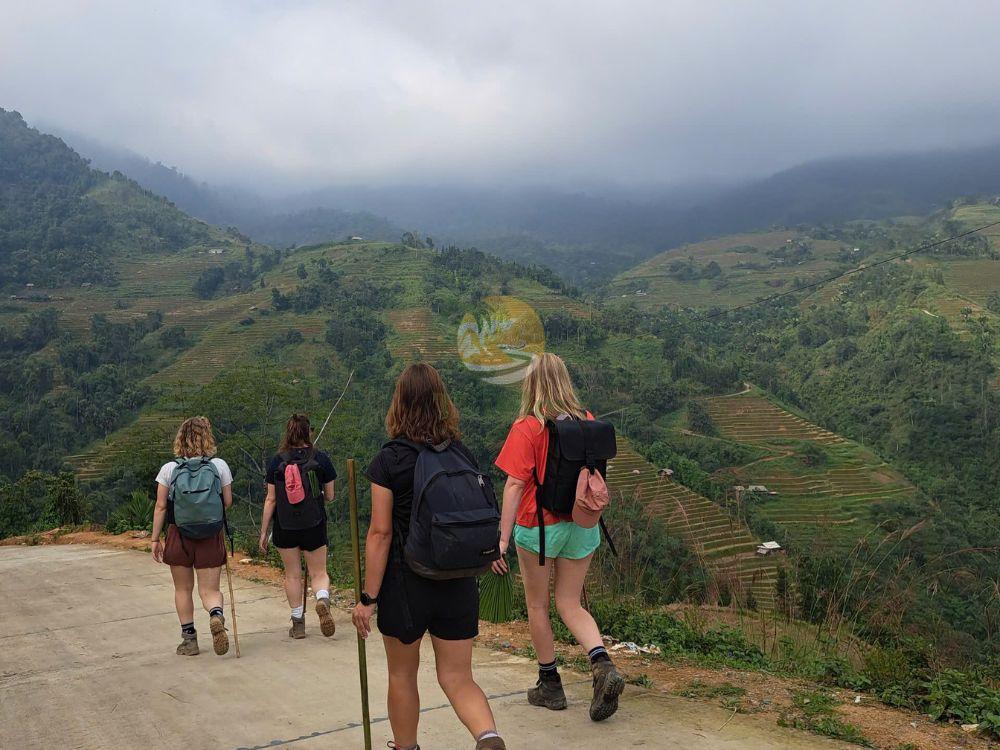
Especially for a small business in the mountains, where every group of visitors carries very real weight: a day’s work for the guide, a meal ordered in the village, a vehicle with somewhere to go, a family with a little extra income.
That’s why, when we say no to a request, we don’t say it out of pride.
We say it out of care.
Because there are trips that, if we take them today, we may not be able to honestly say tomorrow that we love Tay Con Linh.
Some groups want to move fast.
Into the forest in the morning, photographs by noon, back to the city by afternoon.
As many stops as possible.
As little time at each as possible.
They’re not wrong.
They simply need a different kind of experience.
Tay Con Linh doesn’t suit that kind of traveling.
Here, much of what is most beautiful doesn’t show up when you’re in a hurry.
A red clay path after rain needs you to walk slowly to stay safe.
A stretch of cloud forest needs enough quiet for the birdsong to stay close.
A cup of tea in a Dao home needs enough time for the conversation to open naturally — not like a checkbox on a schedule.
If an itinerary forces the guide to keep pushing the group forward, turns the meal in the village into a rushed stop, reduces the forest to a backdrop for a few photos — that is not the kind of trip we want to run.
Some requests want to bring vehicles deeper into the forest to cut walking time.
On the surface, that sounds reasonable.
Everyone wants more convenience.
But not every path should become more convenient.
Some trails in Khuoi My, Lung Vai, and Na Mau were shaped by the footsteps of people going to the forest, picking tea, working the fields — for years.
They were not built to carry extra wheels.
Once a path is widened, the forest never fully returns to what it was.
The soil compacts.
Tree roots are exposed.
Rainwater follows a new course.
And after only a few seasons, a once-narrow trail can become a long scar across a mountain slope.
We don’t want the convenience of one trip today to become a wound in the forest for many years to come.
Some groups too large want to enter a small village.
They think they’ll just stop for a moment.
But for a family living there, one visitor ‘moment’ can be an entire afternoon turned upside down.
A Dao kitchen is not a restaurant.
A courtyard is not a reception area.
A child was not born to become a cultural image in a stranger’s camera.
When the number is right, the host can pour the tea, ask if the guests were cold on the road, talk about the tea season, the rains, the corn, whether the path to the field is muddy or dry today.
That is an encounter.
When there are too many people, it easily becomes a transaction.
And once daily life has been turned into service too many times, the naturalness disappears before anyone notices.
Some people ask us:
‘Can you guarantee we’ll see the Tonkin snub-nosed monkey?’
The answer is always no.
Not because we don’t want visitors to have a memorable experience.
But because wild animals don’t exist to fulfill human expectations.
Whether a group of monkeys appears is the forest’s decision.
They move according to food, weather, safety, signals we don’t always understand.
If we’re lucky enough to see them that day, it’s a gift.
If we don’t see them, the trip hasn’t failed.
The real failure is when humans put pressure on the forest just to capture a moment worth posting online.
For rare species, distance is sometimes the highest form of respect.
There are requests that sound very small but that we still have to decline.
Breaking a flower branch for a photo.
Playing music in the forest.
Entering areas where local people don’t want visitors.
Photographing an elder or a child without asking permission.
Bringing visitors into someone’s home just because ‘it looks authentically local.’
These things may not ruin a trip immediately.
But if repeated often enough, they erode the way tourism treats a place.
And when the way of behaving is wrong, every word about sustainability becomes meaningless.
We don’t claim to always be right.
There are times we think very carefully.
There are requests that, if we accepted, would improve our revenue.
There are refusals that upset visitors.
But running tourism at Tay Con Linh cannot only ask: ‘What do visitors want?’
We also have to ask:
Can the forest handle it?
Is the village comfortable?
Are the local people being respected?
Does the guide still have enough time to do his job properly?
And after this trip, does the place still hold the reason people wanted to come?
If any of those answers is no, we have to stop.
For me, saying no is not turning our backs on visitors.
It’s how we keep our word to Tay Con Linh.
To the people who still live here after the visitor groups leave.
To the forests that cannot say for themselves that they are tired.
To future visitors — so they can still find a place that hasn’t been deformed by today’s easy decisions.
Good tourism is not satisfying every human desire.
Good tourism is knowing when a desire, however legitimate, must still come second to the peace of a place.
There are trips we choose to decline.
Not because we don’t need visitors.
But because we still need Tay Con Linh to be Tay Con Linh.


