

The Dao Ao Dai ethnic group, also known locally as the Dao Cham or Long Dress Dao, is a distinct cultural branch of Vietnam’s Yao minority settled along the steep slopes of the Tay Con Linh mountain range in Ha Giang.
Defined by their elegant knee-length indigo tunics, mastery of high-altitude herbal medicine, and sacred spiritual rituals honoring ancestral deity Ban Vuong, the Dao Ao Dai maintain an extraordinarily preserved highland lifestyle.
Nestled inside the community of Khuoi My Village, TVPalm Ecolodge offers travelers a respectful, direct gateway into this ancient mountain culture.
Who Are the Dao Ao Dai in Ha Giang? History, Identity, and Naming
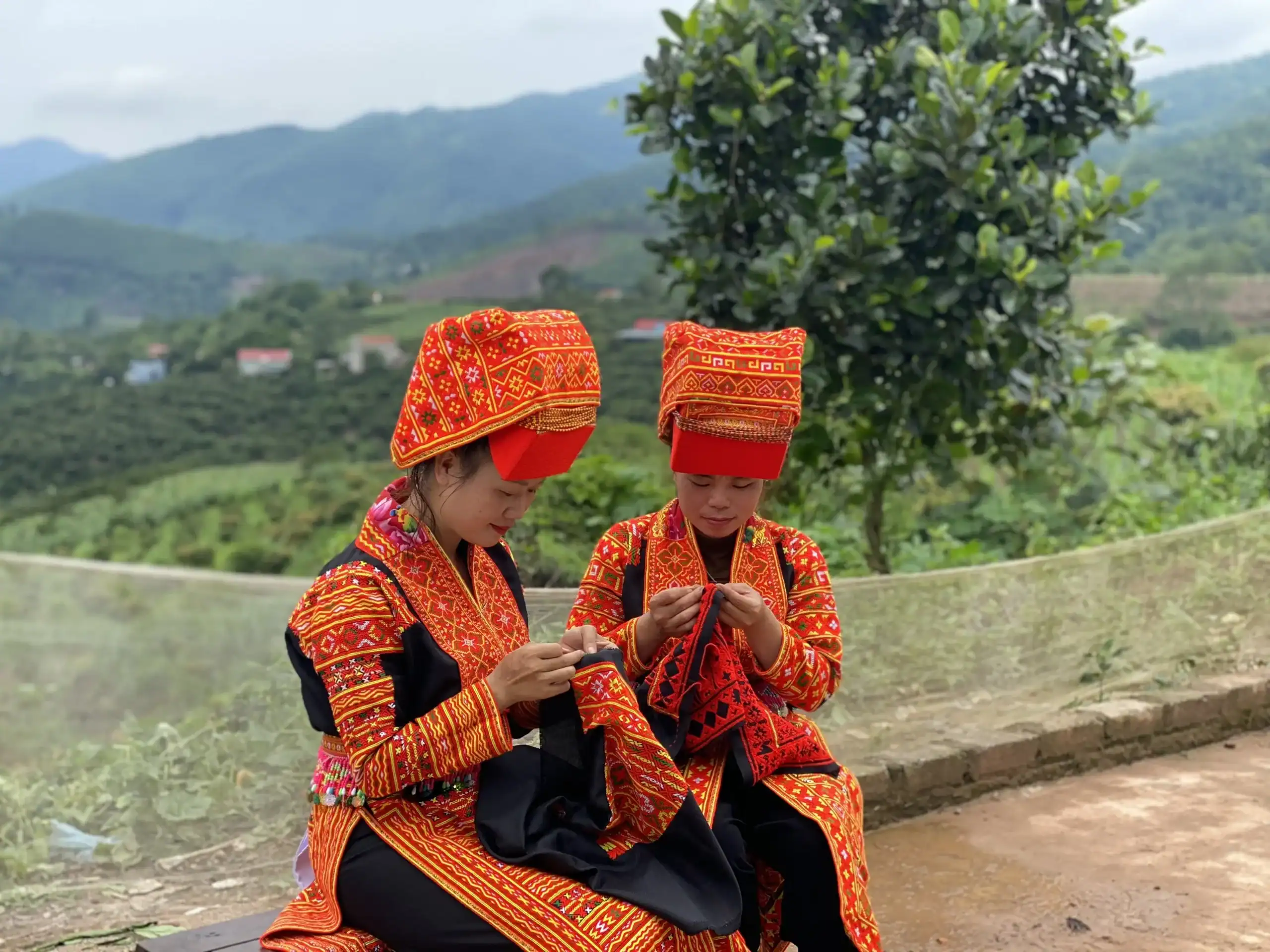
The Dao Ao Dai represent one of the most culturally resilient ethnic subgroups in northern Vietnam. Migrating southward from southern China across several centuries, they settled primarily in the sub-tropical cloud forests flanking the Tay Con Linh massif, where altitudes range from 600 to 1,200 meters.
The name « Dao Ao Dai » derives from the traditional knee-length, dark indigo tunic worn by women, which resembles the silhouette of the Vietnamese national dress while incorporating indigenous embroidery, beeswax batik patterns, and silver torque neck ornaments.
Origins, Migration, and the Distinction Between Dao Subgroups
Across Ha Giang province, the broader Dao ethnic minority accounts for approximately 15% of the total provincial population, divided into several distinct cultural subgroups including the Dao Do (Red Dao), Dao Tien (Coin Dao), and Dao Ao Dai (Long Dress Dao).
While sharing common linguistic roots, mythological ancestry, and religious scriptures written in the ancient ideographic Nom Dao script, each branch developed distinct visual aesthetics, textile traditions, and agricultural lifestyles shaped by their geographic environment.
Unlike the Red Dao, who are instantly recognizable by their voluminous crimson turbans, red wool pom-poms, and heavy chest embroidery, the Dao Ao Dai embrace a refined, minimalist aesthetic. Their everyday and ceremonial attire emphasizes deep, hand-dyed indigo hemp and cotton, accented with narrow geometric borders, red-and-green fringe bonnets, and layered silver torcs.
For a dedicated examination of their weaving and batik craft, explore our comprehensive guide to Dao Ao Dai traditional clothing.
Vernacular Stilt House Architecture on Mountain Slopes
Dao Ao Dai communities reside in traditional raised wooden stilt houses called nha san, constructed entirely from local forest hardwood, bamboo flooring, and thick palm-leaf thatch. Unlike lowland brick houses, these timber dwellings rest on elevated pillars two to three meters above the steep mountain terrain.
This raised structure keeps the living quarters dry during heavy monsoon rains, provides natural ventilation against summer humidity, and protects households from wild animals and damp alpine soils.
The interior of a Dao Ao Dai home centers around the sacred family hearth (bep lua). The hearth is never extinguished; it is the spiritual nucleus of the home where meals are cooked over dried mountain firewood, medicinal herbs are boiled in copper cauldrons, and family elders pass down oral histories to younger generations.
Above the hearth hangs a wooden smoking rack used to cure black pork (thit lon den) and dry seasonal seed grains for the next agricultural cycle.
| Cultural Dimension | Dao Ao Dai (Dao Cham) | Dao Do (Red Dao) |
|---|---|---|
| Traditional Attire | Long knee-length indigo tunic, minimalist embroidery, fringe bonnet | Short jacket, vibrant red wool pom-poms, large crimson turban |
| Primary Geography | Tay Con Linh slopes, Khuoi My, Xa Phin, Vi Xuyen district | High karst plateau passes, Quan Ba, Dong Van, Hoang Su Phi |
| Textile Technique | Beeswax batik resist printing, deep natural indigo kettle immersion | Intricate cross-stitch needlework with multicolored silk threads |
| Dwelling Style | Traditional timber stilt houses (nha san) with thatched palm roofs | Half-stilt half-earthen dwellings or rammed-earth stone houses |
| Key Agricultural Craft | Centuries-old organic Shan Tuyet tea foraging and wet rice terraces | Terraced cardamom cultivation, corn crops, and mountain foraging |
Sacred Spiritual Beliefs, Ancestral Worship, and the Cap Sac Ceremony
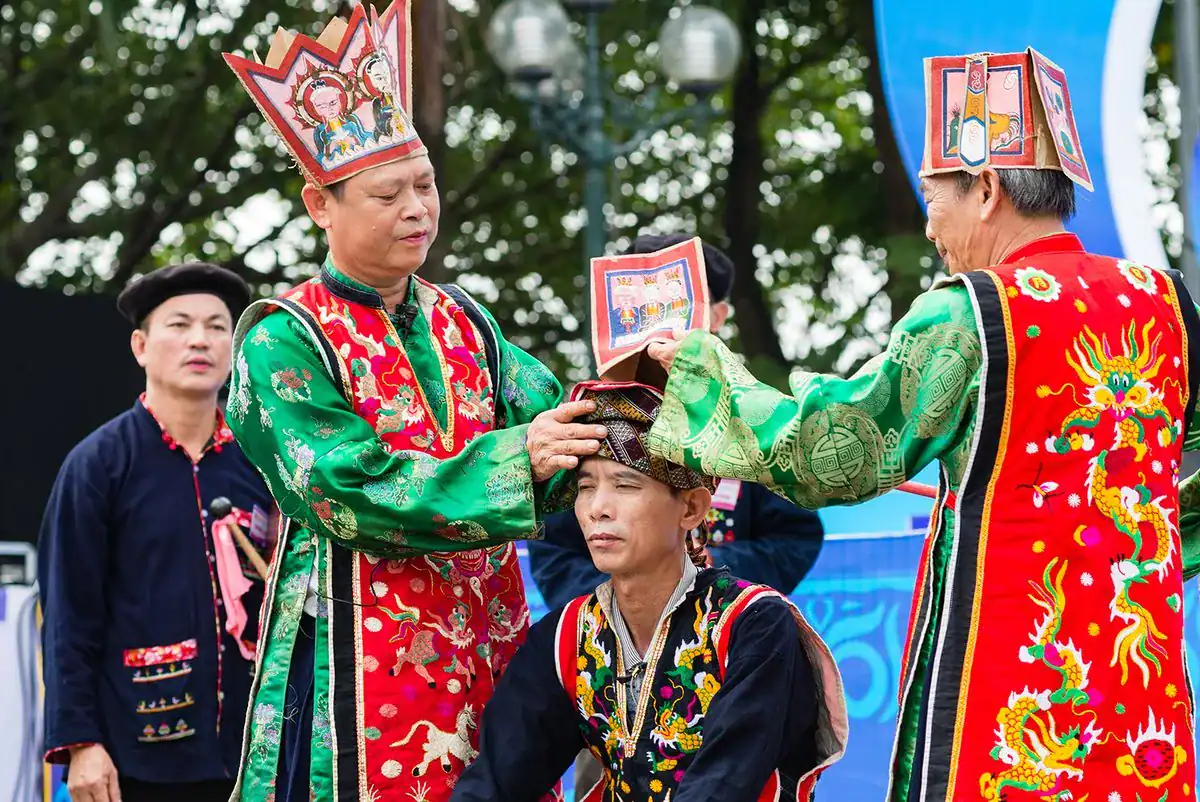
Spirituality forms the foundation of daily existence for the Dao Ao Dai. Their worldview blends animist reverence for natural forest spirits with ancient Taoist cosmology and ancestral devotion.
Every mountain stream, old-growth tree, and limestone ridge is believed to possess guardian spirits (than rung), requiring seasonal blessings and respectful environmental stewardship from the village collective.
Veneration of Ban Vuong and Ancestral Spirit Cosmology
At the center of Dao spiritual lineage is the worship of Ban Vuong (Pan Hu), the legendary canine-dragon progenitor of the twelve ancient Dao clans. According to sacred origin myths preserved in ancient handwritten Nom Dao manuscripts, Ban Vuong secured peace for the kingdom and earned imperial sanction for his descendants to roam the mountain highlands freely without taxation.
In every Dao Ao Dai household, the ancestral altar occupies the highest, most respectful location in the main hall, adorned with ritual paper cutouts, incense pots, and ceremonial wine cups.
The Sacred Cap Sac Ordination: Journey into Spiritual Adulthood
The most important rite of passage in the life of a Dao male is the Le Cap Sac (Ordination or Coming-of-Age Ceremony). Without undergoing Cap Sac, a man is not recognized as a full spiritual adult by the community or ancestral spirits, regardless of his chronological age. He cannot lead ancestral worship ceremonies, conduct marital blessings, or be welcomed into the spirit realm upon passing.
Conducted over several days and nights under the direction of high-ranking village shamans (thay cung), the ceremony involves intense purification rites, rhythmic bell chanting, and dramatic spiritual trials. Depending on the family’s spiritual tradition, the initiate undergoes a three-lamp (cap 3 den) or seven-lamp ordination.
Shamans don ceremonial paper crowns, unveil sacred scroll paintings depicting the Taoist pantheon, and bestow the initiate with a new sacred name recorded in the clan ledger. The entire village participates, celebrating with communal feasts of roasted pork, wild bamboo shoot broth, and generous toasts of fragrant corn wine.
While the coming-of-age ordination represents an individual’s spiritual milestone, communal life in the highlands is punctuated by vibrant seasonal ceremonies throughout the lunar year. To experience ancestral dance rituals, sacred fire walking, and harvest celebrations, explore our comprehensive guide to Dao ethnic festivals Ha Giang.
Botanical Wisdom, Ancient Tea Forests, and Visiting Khuoi My Village

Centuries of coexistence with the dense biodiversity of Tay Con Linh have endowed the Dao Ao Dai with extraordinary Dao ethnic herbal medicine expertise. Passed down matrilineally from grandmothers to daughters, this living botanical library underpins their physical well-being, traditional diet, and sustainable mountain economy.
Forest Herbalism and the Legendary Red Dao Medicinal Bath
Foremost among their botanical practices is the traditional herbal bath, a wellness remedy revered across Vietnam. Women venture deep into primary cloud forests to hand-forage more than thirty species of wild medicinal roots, barks, vines, and leaves.
The harvested herbs are chopped fresh, boiled continuously in large iron pots over hardwood fires for three to four hours, and decanted into round wooden soaking barrels made from fragrant cedar timber.
Soaking in the steaming, aromatic amber bath liquor opens skin pores, stimulates deep blood circulation, relaxes strained muscles after rugged mountain treks, and soothes joint pain. The formula is traditionally used by Dao mothers within days of giving birth to restore physical vigor and immunity.
To understand the botanical properties and historical roots of this therapy, read our field guide on Red Dao herbal bath benefits.
Harvesting Centuries-Old Shan Tuyet Tea on Tay Con Linh
In high mountain villages like Khuoi My and Xa Phin, the Dao Ao Dai are the hereditary custodians of wild ancient Shan Tuyet tea trees. These venerable trees grow at altitudes above 1,000 meters, their gnarled trunks coated in thick moss and mountain lichen. Reaching heights of six to ten meters, harvesters must skillfully climb into the canopy to pluck tender spring buds coated in protective white down.
Following harvest, Dao tea artisans pan-fire the leaves in wood-burning cast iron woks, hand-rolling them on textured bamboo mats to release fragrant alpine aromatics. This ancient tea culture provides a vital, sustainable income stream for village families, directly supporting forest conservation and reducing reliance on slash-and-burn farming.
Cultural Etiquette for Visiting Dao Ao Dai Communities
Visiting a traditional Dao Ao Dai mountain village is an unforgettable cultural experience, but foreign travelers must navigate these communities with mindfulness and respect. Adhere to these essential etiquette practices during your stay:
- Remove Shoes at the Timber Threshold: Always take off your trekking boots before ascending the wooden entrance ladder or crossing onto the stilt house floorboards.
- Do Not Point Feet Toward the Altar: When sitting on floor mats in the main living hall, tuck your legs neatly or sit cross-legged; never point the soles of your feet toward the ancestral altar.
- Ask Permission Before Taking Portraits: Always gesture politely and ask with a smile before photographing village elders, artisans at work, or children in the lanes.
- Respect Hearth Taboos: Never step over the open fire hearth, kick burning firewood logs, or use the hearth fire to burn trash or plastic wrappers.
- Accept Welcome Offerings with Both Hands: When offered tea or a small glass of corn wine by household elders, receive the vessel with both hands as an authentic gesture of gratitude.
Understanding household customs ensures meaningful interactions and protects sacred traditions when traveling through remote mountain settlements. Before visiting highland communities, review our essential handbook on Ha Giang ethnic village etiquette to master homestay hospitality rules, altar protocols, and photography courtesies across diverse ethnic minority cultures.
“The Dao Ao Dai have lived in harmony with the mist and ridges of Tay Con Linh for centuries. When you walk gently through their mountain hamlets, listen to the crackle of the wood hearth, and accept their hospitality, you are connecting with one of the purest living cultural heritages in Southeast Asia.”
Văn Trung Nguyễn, Founder of TVPalm Ecolodge & Adventure
Frequently Asked Questions About the Dao Ao Dai Ethnic Group
Where can travelers visit authentic Dao Ao Dai villages in Ha Giang?
The most authentic and preserved Dao Ao Dai communities are located in the Tay Con Linh mountain foothills just 6 to 12 kilometers west of Ha Giang City. Primary settlements include Khuoi My Village, the celebrated Xa Phin mossy roof village, and Na Thac Village in Vi Xuyen district. These hamlets feature traditional timber stilt houses surrounded by cascading rice terraces and ancient tea trees, far removed from commercial tourist routes.
What is the significance of the knee-length tunic in Dao Ao Dai culture?
The signature long tunic (ao dai) represents both ancestral pride and practical mountain adaptation. Woven from durable homegrown hemp and dyed in natural forest indigo, the garment protects harvesters from sharp thorny undergrowth, mountain leeches, and chilly alpine winds while climbing steep slopes.
The subtle embroidered geometric patterns on collars and lapels serve as clan talismans, warding off malevolent forest spirits according to traditional folklore.
How can travelers respectfully experience a Dao Ao Dai herbal bath?
You can experience authentic herbal baths at established community homestays and eco-lodges such as TVPalm Ecolodge in Khuoi My. Hosts boil fresh wild herbs gathered from the mountain and prepare private wooden tubs.
Guests should rinse with clean warm water before entering the wooden barrel, soak comfortably for 15 to 25 minutes, and avoid drinking cold beverages immediately afterward to maximize therapeutic heat circulation.


