

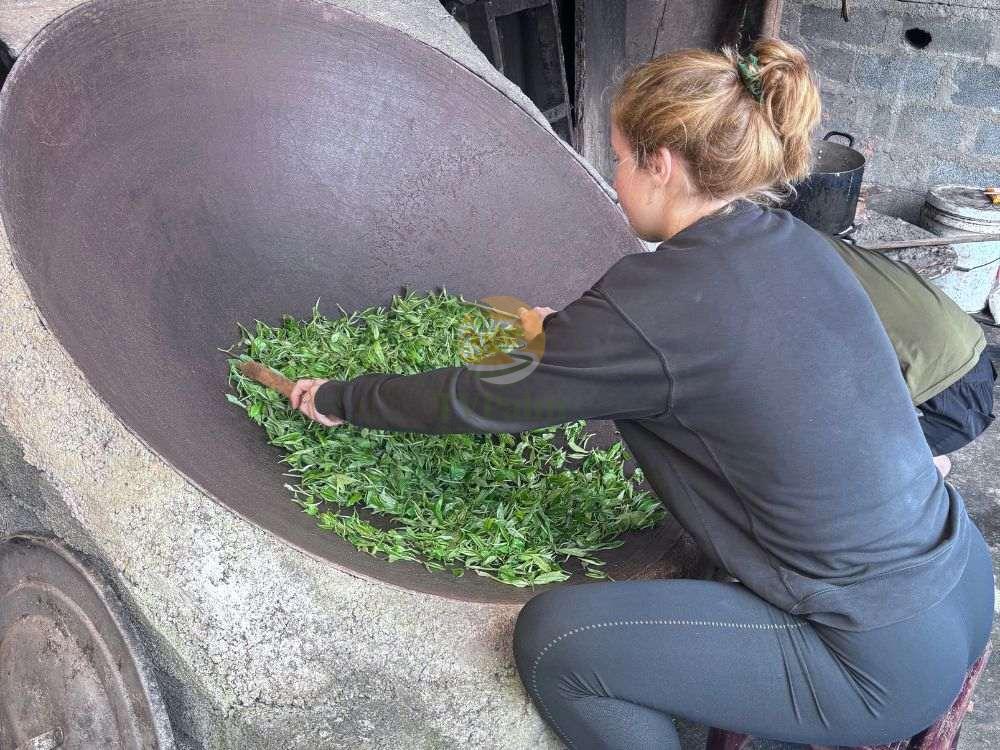
Shan Tuyet tea processing in Ha Giang is an exacting artisanal craft developed over generations by Dao and Hmong master tea makers along the cloud-wrapped slopes of the Tay Con Linh range.
Hand-harvested from centenary wild trees standing between 1,200 and 2,400 meters above sea level, fresh buds undergo precise ambient withering, high-heat cast-iron pan-firing, gentle hand-rolling, and slow charcoal drying.
This meticulous craftsmanship preserves the tea’s signature silvery-white down while concentrating delicate mountain floral aromas, vegetal sweetness, and deep mineral aftertastes.
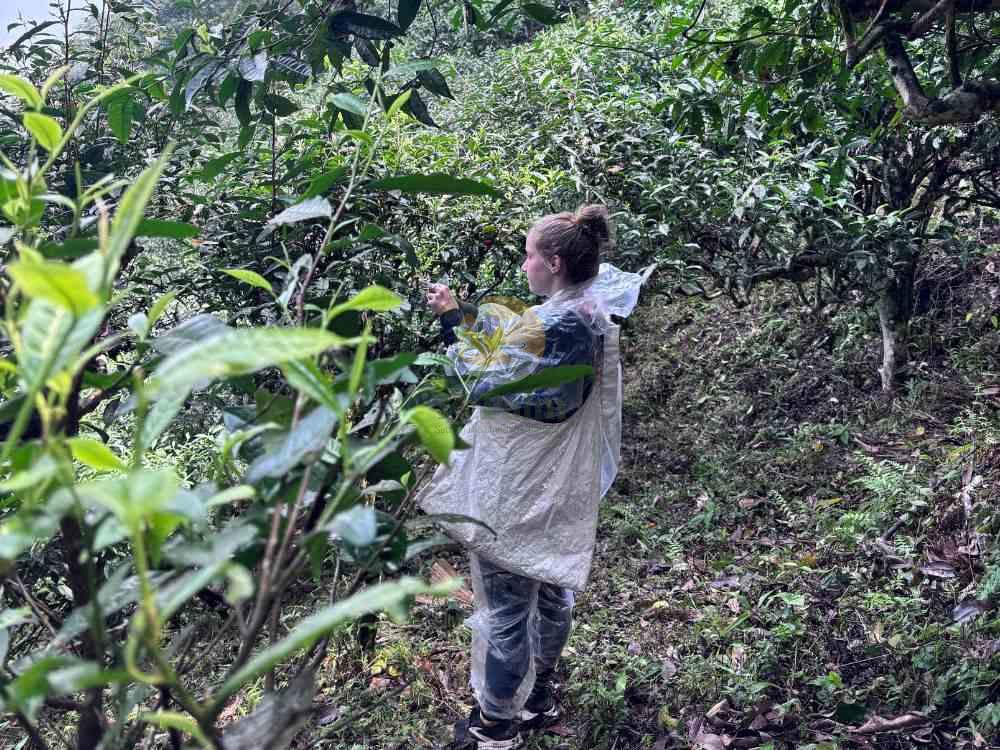
From Cloud Canopy to Bamboo Tray: The Morning Harvest Protocol
Unlike commercial plantation tea bushes kept at waist height through mechanical trimming, ancient Shan Tuyet tea trees (Camellia sinensis var. assamica) grow as tall, wild forest giants reaching heights of 8 to 15 meters.
Harvesters, predominantly experienced Dao and Hmong women, must scale moss-covered limbs and balance precariously in the high canopy to reach the tenderest terminal foliage.
Harvesting follows strict botanical standards designed to safeguard the tea tree’s health while ensuring superior infusion quality. The morning collection routine operates under three core rules:
- The Dawn Harvest Window: Plucking begins at first light, between 5:30 AM and 9:00 AM, while morning mist still blankets the ridges. Gathering before strong direct sunlight evaporates atmospheric moisture prevents premature enzymatic oxidation of raw leaves.
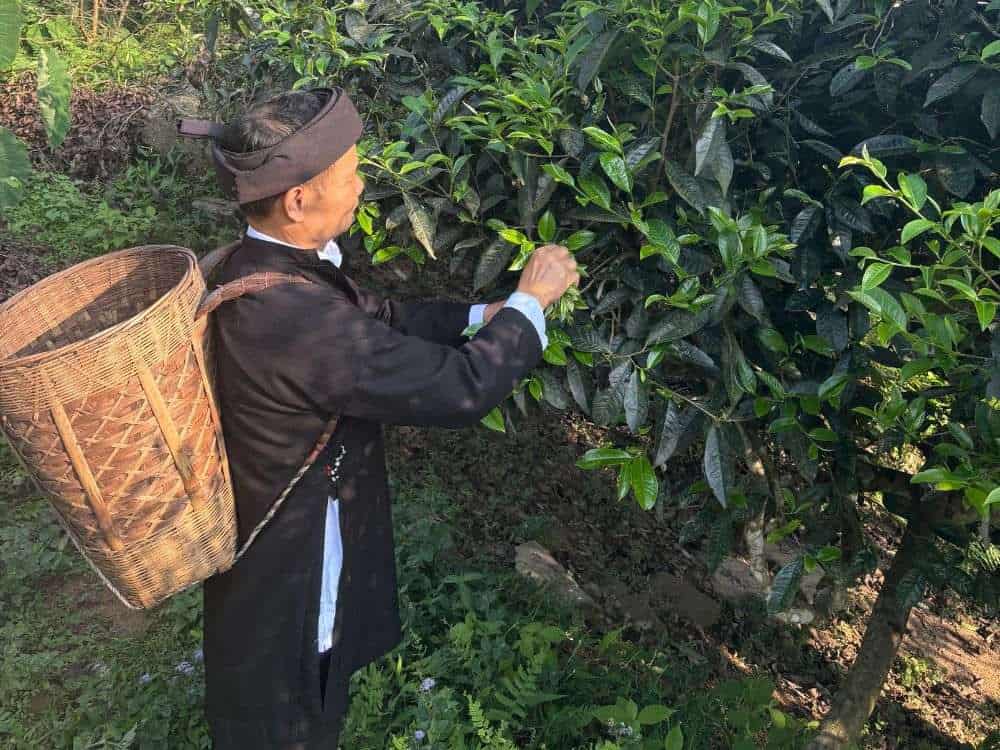
- The One-Bud Picking Standard: The finest grade of Shan Tuyet, destined for premium White Tea (Bạch Trà), requires harvesting only the unopened terminal bud (known as 1 tôm). Standard reserve grades harvest the bud alongside its adjacent tender leaf (1 tôm 1 lá). Older coarse foliage is never picked for specialty tea.
- Delicate Handling: Fresh shoots are placed loosely into woven bamboo backpacks (quẩy tấu) lined with breathable cloth. Tightly packing leaves causes internal heat buildup, bruising delicate cell walls and ruining tea clarity.
The Classical Processing Stages: Science Meets Highland Craft
Transforming freshly plucked wild tea leaves into aromatic dried tea requires navigating a five-step physical and chemical journey. Each phase demands precise sensory evaluation: the master craftsman monitors aroma shifts, tactile leaf tenderness, and heat levels without digital thermometers.

Stage 1: Ambient Withering (Héo Nhẹ)
Immediately upon returning from the forest, tea pickers spread the harvest thinly across raised bamboo racks inside well-ventilated wooden workshops. High-altitude ambient withering takes between 4 and 8 hours depending on humidity levels. During withering, leaves lose approximately 20% to 30% of their cellular moisture, becoming pliable and soft.
This gentle moisture loss triggers crucial biochemical breakdown: leaf starches convert into simple sugars, harsh green grassy odors dissipate, and complex volatile aromatics resembling white orchid and wild honey begin to emerge.
Stage 2: Cast-Iron Pan-Firing and Kill-Green (Diệt Men)
The defining technical step for traditional green and yellow Shan Tuyet teas is pan-firing, known internationally as « kill-green » (or diệt men in Vietnamese). Freshly withered leaves are tossed into a large, concave cast-iron wok heated over a raging hardwood fire to temperatures between 250°C and 300°C.
The craftsman continuously tosses and turns the leaves with bare hands or wooden paddles for 8 to 12 minutes. Intense heat deactivates polyphenol oxidase enzymes within seconds, permanently halting oxidation.
This chemical fixation preserves the vibrant emerald color of the leaf interior and maintains high natural levels of epigallocatechin gallate (EGCG) antioxidants.
Stage 3: Hand-Rolling and Leaf Shaping (Vò Chè)
Once removed steaming hot from the cast-iron wok, the softened leaves are transferred immediately to circular bamboo trays for hand-rolling. Working rhythmically in circular motions for 15 to 25 minutes, the artisan twists the leaves into tight, uniform curls.
Rolling serves two critical functions: it ruptures internal plant vacuoles to coat the leaf exterior with concentrated sap, which will dissolve readily into hot water during brewing, and it compresses the leaf volume for storage.
The greatest technical challenge is applying firm pressure to curl the leaf without stripping away the prized white down hairs (lông tuyết) that give the tea its name.
Stage 4: Controlled Oxidation (For Black and Red Styles)
While green Shan Tuyet tea bypasses oxidation completely, producing Black Tea (Hồng Trà) requires an extensive enzymatic fermentation stage. Rolled leaves are arranged in bamboo fermentation boxes under controlled alpine humidity (85% to 90%) and ambient temperatures of 22°C to 26°C for 4 to 6 hours.
As oxygen reacts with catechins, the leaves transform from deep forest green to copper-red. The chemical oxidation generates theaflavins and thearubigins, shifting the flavor palette toward notes of dried apricot, dark molasses, malt, and caramelized forest honey.
Stage 5: Wood-Fire Roasting and Final Dehydration (Sấy Khô)
The final processing stage reduces residual moisture below 5% to prevent mold formation and ensure long-term shelf stability. Rolled leaves are spread over finely woven bamboo screens positioned above glowing hardwood charcoal embers.
Drying occurs in two stages: an initial high-temperature roast at 85°C to 95°C for 30 minutes to set leaf shape, followed by gentle, slow dehydration at 65°C to 75°C for two to three hours. Pure charcoal from native mountain timbers imparts a subtle, clean mineral warmth to the dry leaves without overwhelming their natural botanical bouquet.
| Processing Stage | Applied Heat (°C) | Target Moisture Content | Key Biochemical Objective | Sensory Quality Impact |
|---|---|---|---|---|
| 1. Ambient Withering | 18°C to 24°C (ambient) | Drops from 78% to 65% | Starch conversion, enzyme activation | Eliminates raw grassy astringency |
| 2. Pan-Firing (Kill-Green) | 250°C to 300°C (wok surface) | Drops to approximately 50% | Deactivates polyphenol oxidase | Locks in emerald color and EGCG antioxidants |
| 3. Hand-Rolling | 40°C to 50°C (residual) | Maintained at 45% to 50% | Ruptures cellular vacuoles | Coats leaf surface with essential aromatic oils |
| 4. Controlled Oxidation | 22°C to 26°C (ambient) | Maintained at 45% | Synthesizes theaflavins and thearubigins | Develops amber color, malt, and honey notes |
| 5. Charcoal Drying | 65°C to 95°C (charcoal heat) | Final moisture below 5% | Halts all microbial reactions | Crisp needle curl, shelf stability up to 5 years |
Artisanal Tea Styles: White, Green, Red, and Fermented Profiles
The exceptional raw material harvested from Tay Con Linh ancient tea trees allows master producers to craft four fundamentally distinct tea categories from identical mountain foliage, simply by varying processing temperature, rolling pressure, and oxidation duration.
Comparative Breakdown of the Four Master Styles
Each style expresses the unique minerality of the northern mountain ranges through a distinct sensory lens. The table below compares the processing standards and flavor signatures of Ha Giang’s primary artisanal tea types:
| Tea Classification | Plucking Standard | Oxidation Level | Liquor Color | Primary Tasting Notes |
|---|---|---|---|---|
| Shan Tuyet White Tea (Bạch Trà) | Unopened single bud (1 tôm) | 0% (Natural ambient sun/shade wither only) | Pale champagne or shimmering platinum | Wild meadow flowers, raw acacia honey, white peach, delicate mineral sweetness |
| Shan Tuyet Green Tea (Lục Trà) | One bud, one leaf (1 tôm 1 lá) | 0% (Deactivated via high-heat pan-firing) | Luminous pale amber-yellow with jade tint | Young sticky rice, roasted chestnut, forest moss, profound lingering sweetness (hậu ngọt) |
| Shan Tuyet Red Tea (Hồng Trà) | One bud, one or two leaves | 100% (Full enzymatic aerobic oxidation) | Deep ruby red to mahogany | Stewed dark plums, dried longan, malt, dark caramel, zero astringency |
| Aged Mountain Tea (Trà Phổ Nhĩ / Trà Vàng) | Mature forest leaves and bud clusters | Post-fermented (Microbial pile fermentation) | Deep reddish-brown or cognac | Damp forest floor, medicinal roots, weathered cedar wood, sweet earthy smoothness |
Brewing Protocol: Temperatures, Water Quality, and Multi-Steep Longevity
A masterfully processed Shan Tuyet tea requires knowledgeable preparation to unlock its multi-layered aromatic complexity. Because ancient tree leaves possess thick cellular membranes packed with dense polyphenols, they exhibit remarkable endurance across multiple infusions:
- Water Temperature: Never use rolling boiling water directly on delicate White or Green styles. Brew White Tea at 80°C to 85°C to preserve floral aromatics. Green Shan Tuyet excels at 85°C to 90°C. Red and aged fermented styles require near-boiling water at 95°C to 100°C to extract deep theaflavins.
- Water Chemistry: Use pure mountain spring water or soft filtered water with low total dissolved solids (TDS below 50 ppm). Highly chlorinated municipal tap water destroys subtle herbal nuances.
- Multi-Steep Longevity: While commercial plantation tea fades after two or three infusions, high-altitude ancient Shan Tuyet leaves easily yield 8 to 12 distinct steepings, with the sweet throat resonance (hậu ngọt) intensifying between the third and sixth rounds.
« When you sip a cup of Shan Tuyet, you drink centuries of mountain rain, winter fog, and forest sunlight. Our job as tea masters is not to force flavors into the leaf, but to guide the fire and wind so the ancient tree can tell its own story. »
Văn Trung Nguyễn, TVPalm Expedition Specialist
To dive deeper into the botanical ecology of these centennial forests, explore our comprehensive guide to ancient Shan Tuyet tea trees, sustainable harvesting practices in organic Shan Tuyet tea in Vietnam, the moss-carpeted architecture of Xa Phin mossy roof village, and cultural traditions in our guide to Ha Giang ethnic village etiquette.
Frequently Asked Questions
What causes the white down fuzz (lông tuyết) on Shan Tuyet tea leaves?
The white fuzz consists of microscopic glandular hairs known as plant trichomes. Wild tea trees growing at high altitudes between 1,200 and 2,400 meters develop these dense silver coats to insulate young shoots from sub-zero mountain frosts, regulate extreme alpine temperature shifts, and ward off herbivorous insects.
Why is traditional cast-iron pan-firing preferred over modern machine steaming?
Wood-fired cast-iron pan-firing imparts dry, conductive heat that rapidly stops enzyme activity without introducing moisture. This traditional technique produces a richer roasted-rice aroma, maintains structural firmness for hand-rolling, and protects the delicate white trichomes far better than mechanical high-pressure steam ovens.
How long can artisan Shan Tuyet tea be stored before losing its flavor?
Properly dried Shan Tuyet tea with moisture content below 5% can be kept in airtight containers for two to three years without degradation. Fermented Black and compressed Pu-erh styles actually improve with age, developing deeper honey, dried fruit, and antique cedar wood notes over 5 to 10 years of cellar storage.


