

On the mist-shrouded eastern slopes of Mount Tay Con Linh in Ha Giang, ancient Shan Tuyet tea trees rise like forest giants, tended by indigenous Dao Ao Dai families across generations. As founder of TVPalm, I have guided private walking journeys through these living groves, connecting mindful travelers with authentic mountain heritage.
This field guide shares local insights into how these wild trees thrive, how villagers harvest high canopy buds, how leaves are pan-roasted over wood fires, and how to steep each cup to perfection.
What are ancient Shan Tuyet tea trees on Tay Con Linh?
Ancient Shan Tuyet tea trees (Camellia sinensis var. shan) are wild arbor trees native to the primeval cloud forests of Mount Tay Con Linh in Ha Giang. Unlike commercial shrubs clipped to waist level, these centenarian giants germinate naturally from seed and reach heights up to fifteen meters between 900 and 2,000 meters elevation.
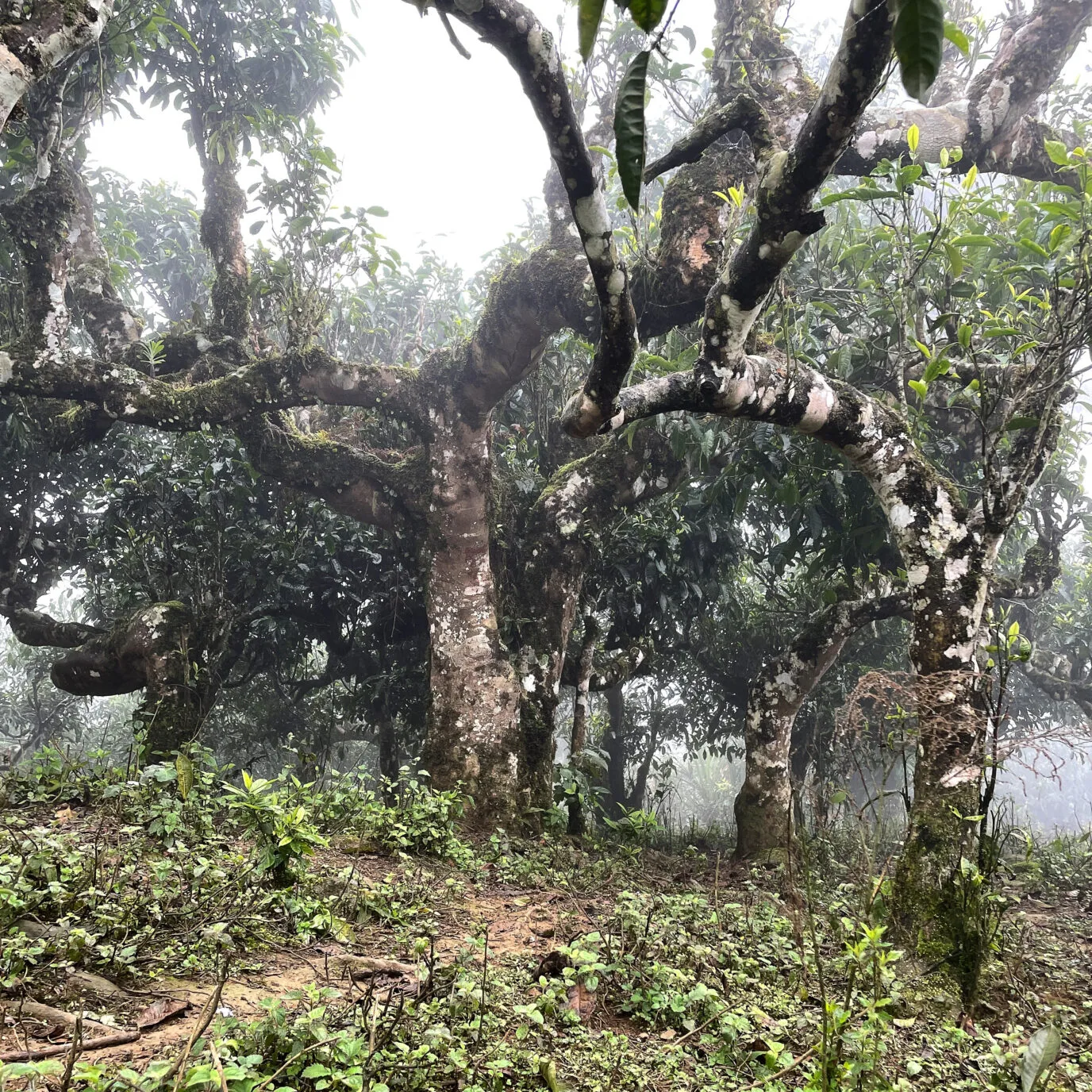
Their name means “Snow on the Mountain”-Shan signifies highland summits and Tuyet describes the silver downy coat protecting tender spring shoots from alpine frost. Mature specimens feature mossy trunks measuring 1.5 to 2.5 meters in circumference.
Growing on granite ridges where humidity exceeds 85% and daily temperatures fluctuate by 10 to 15°C, this microclimate slows leaf development, concentrating aromatic oils and sweetness in each bud.
| Agronomic Feature | Ancient Shan Tuyet Trees (Tay Con Linh) | Lowland Plantation Tea (Industrial) |
|---|---|---|
| Botanical Classification | Camellia sinensis (arbor tree) | Camellia sinensis var. sinensis (pruned shrub) |
| Tree Lifespan | Centuries old (200 to 500+ years) | 15 to 30 years before commercial replanting |
| Growth Height | 6 to 15 meters tall (requires tree climbing) | 0.8 to 1.2 meters (mechanically hedge-pruned) |
| Habitat Elevation | 900 to 2,427 meters above sea level | 100 to 600 meters in lowland agricultural zones |
| Root Structure | Deep vertical taproots anchoring 3 to 6 meters | Shallow lateral root systems (0.5 to 1 meter) |
| Agricultural Inputs | Zero chemical fertilizers or synthetic sprays | Periodic synthetic fertilizers and pesticides |
| Annual Flushes | 3 to 4 seasonal flushes harvested by hand | 15 to 20 mechanical harvest cycles annually |
Ancestral tree-climbing harvest and wood-fired tea crafting
Harvesting Shan Tuyet tea requires agility and balance. Indigenous Dao Ao Dai artisans scale mossy limbs barefoot, hand-plucking tender shoots in the high canopy while morning mist blankets the ridges.
Harvesting follows strict traditional guidelines to protect ancient trees:
- Dawn timing: Plucking begins at dawn while mist envelopes the canopy, preventing sunlight from withering tender buds.
- One bud two leaves (mot tom hai la): Harvesters pick only the unopened spear bud (known as tom in Vietnamese tea culture) and two adjacent young leaves, leaving mature foliage to nourish the tree.
- Gentle pinching: Shoots are pinched cleanly between fingertips without tearing bark or bruising delicate leaves.
- Breathable baskets: Fresh shoots rest in open-weave bamboo baskets, allowing airflow to prevent heat buildup.
Traditional tea crafting begins the same afternoon in village kitchens across Khuoi My, Na Thac, and Cao Bo. Dao Ao Dai families transform freshly plucked mountain leaves through four simple, time-honored artisanal steps using wood-fired cast-iron pans:

- Gentle withering (Heo nhe): Fresh shoots are spread thinly on raised bamboo trays in a cool, shaded room for several hours. This softens the leaves, removes excess surface moisture, and releases a fresh herbal fragrance.
- Pan roasting (Sao diet men): Artisans quickly toss the soft leaves by hand inside large cast-iron woks heated over crackling hardwood fires. This quick heat halts the leaves from turning brown, locking in their vibrant green color and fresh alpine aroma while keeping the delicate silver fuzz silky and intact.
- Hand rolling (Vo che): While the leaves remain warm and pliable from the pan, tea masters roll and press them rhythmically across woven bamboo mats. This hand twisting releases natural aromatic oils to coat the leaf surface and shapes them into graceful curls.
- Slow drying (Say kho): The curled leaves are dried slowly over gentle wood embers until thoroughly crisp. This final step seals in the tea’s floral sweetness, allowing it to keep its fresh aroma for years without spoiling.
By adjusting how the freshly picked leaves rest and dry, village artisans craft four distinct styles of tea from the same ancient trees:
- White tea (Bach tra): Made purely from silver unopened buds dried naturally in the mountain air without any pan heat, yielding a delicate, pale liquor with hints of wildflower honey.
- Green tea (Tra xanh): Pan-roasted over wood fire immediately after harvest to preserve fresh mountain brightness, creating a golden-green tea with warm aromas of toasted chestnuts.
- Black tea (Hong tra): Leaves are gently rolled and allowed to darken naturally in the fresh mountain air before drying, yielding a deep copper-amber tea with rich notes of dried plum, caramel, and honey.
- Aged dark tea (Tra pho nhi): Mature leaves are naturally aged and pressed into firm tea cakes, developing an earthy, woody character that grows smoother, sweeter, and more complex over time, much like a fine aged vintage.
| Harvest Season | Harvest Months | Typical Liquor Hue | Aroma and Taste Character |
|---|---|---|---|
| Spring First Flush | Late March to Early May | Pale amber-gold | Wild mountain orchid, honey, sweet finish |
| Summer Flush | Late June to Early August | Deep golden-yellow | Rich herbal notes, bold brisk finish |
| Autumn Harvest | September to November | Warm luminous amber | Baked chestnut, caramel undertones |
| Winter Dormancy | December to Early March | No harvest | Trees rest in freezing clouds, gathering nutrients |
Sensory tasting profile and the art of tea steeping
A properly steeped cup of Shan Tuyet tea yields a glowing amber liquor with wild orchid aroma, crisp mountain minerality, and a persistent sweet resonance in the throat (hau vi). Old-growth Shan Tuyet balances pleasant briskness with deep nectar warmth, never turning harsh or astringent when infused with care.

This complex mouthfeel stems from rich natural tea polyphenols and L-theanine, promoting calm mental focus without caffeine jitters. Mountain families steep their tea exclusively with soft granite spring water filtered naturally through bedrock, dissolving delicate aromatic oils without muting natural sweetness.
To prepare and steep ancient Shan Tuyet tea using traditional Gongfu teaware:
- Select porcelain or clay teaware: Use a glazed gaiwan or clay teapot (100 to 120 ml capacity) preheated with hot water.
- Measure leaf ratio: Use 5 to 6 grams of whole dried leaf for 100 to 120 ml of fresh spring water, maintaining a balanced 1:20 ratio.
- Calibrate water temperature: Heat spring water to 85°C to 90°C for delicate green and white styles to protect downy leaf hairs, or 95°C for rich black and aged dark styles.
- Awaken the leaves with a flash rinse: Pour hot water along the vessel wall and pour it out within three seconds to awaken the aroma without pulling out bitterness.
- Steep in short infusions: Infuse for 15 to 20 seconds initially, adding 5 seconds to subsequent rounds across 8 to 12 separate steepings.
Standing beneath a four-hundred-year-old tea tree as woodsmoke curls from a nearby village hearth reminds you that tea here is not an industrial commodity. It is living history, preserved by mountain families who understand that real quality cannot be rushed.
Nguyễn Văn Trung, Founder of TVPalm
Walking to ancient tea groves with TVPalm Routes and community ethics
Visiting Tay Con Linh tea forests is conducted as an intimate, low-impact private walk departing from TVPalm Ecolodge into Dao Ao Dai villages like Na Thac, Khuoi My, and Cao Bo. Traveling on foot protects fragile root systems while providing direct income to local guides and hosts, reflecting sustainable standards supported by Vietnam National Tourism.
Two recommended walking itineraries explore these living heritage groves:
| Itinerary Route | Walking Distance | Elevation Profile | Cultural Experience |
|---|---|---|---|
| Na Thac Village Day Walk | 3.25 km each way (4 to 5 hours) | Ascends from 379m to 609m | Visit family tea workshops, pick leaves, and share lunch |
| Deep Tay Con Linh Summit Circuit | 28 to 32 km (2 Days 1 Night) | Ascends through groves to 2,427m | Trek primeval cloud forests, overnight in Dao homestays |
Guests stay in comfort at TVPalm Ecolodge near Khuoi My, walking with village elders who tend trees organically. Trails connect naturally with Xa Phin mossy roof village, showcasing traditional palm-thatched architecture.
Frequently asked questions
How old are the oldest Shan Tuyet tea trees in Ha Giang?
The oldest Shan Tuyet tea trees on Mount Tay Con Linh range from 200 to over 500 years old. In Cao Bo commune, 220 centenarian trees hold official Vietnam Heritage Tree status from VACNE (Vietnam Association for Conservation of Nature and Environment), while regional surveys record over 1,300 ancient specimens across high-altitude communes of Ha Giang province.
When is the premier season to visit the ancient tea forests?
Late March through early May offers the prime window during the spring first flush, when trees produce silvery buds and village kitchens fill with roasting aromas. Autumn from September to November offers pleasant weather alongside golden terraced rice fields.
How does the caffeine content of Shan Tuyet compare to coffee?
A cup of Shan Tuyet tea contains 30 to 50 milligrams of caffeine, roughly half that of coffee. Its high L-theanine content promotes sustained mental focus without jittery energy spikes or rapid crashes.
Written by Nguyễn Văn Trung, founder of TVPalm. He has led small-group trips across Northeast Vietnam since 2021.


