

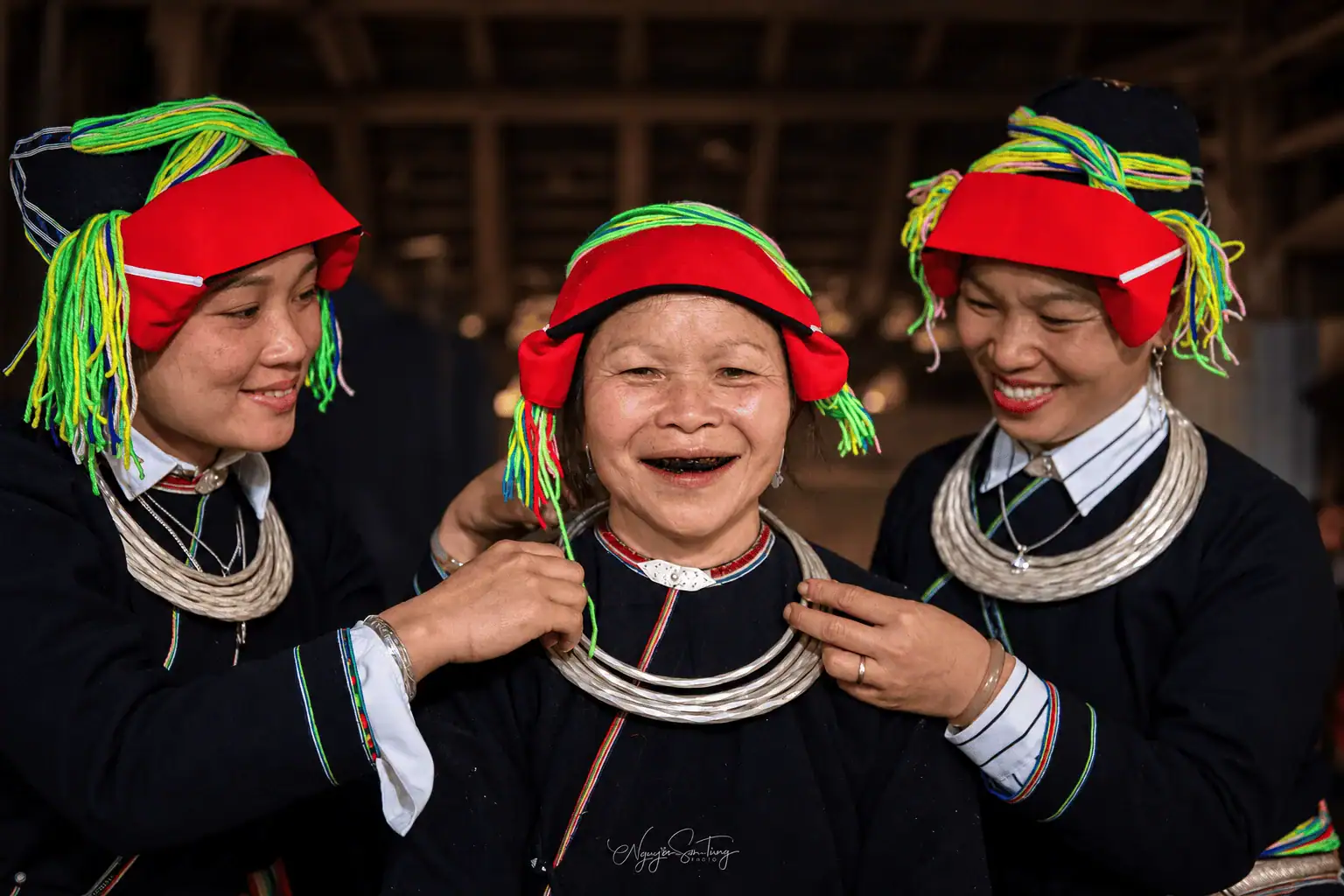
The Dao Ao Dai, or Long-Tunic Dao, are a culturally distinct highland group living on the slopes of Mount Tay Con Linh in Ha Giang, northern Vietnam.
At TVPalm Ecolodge, our daily work connects directly with these communities in Khuoi My, Xa Phin, and Na Thac, where our indigenous team members grew up among ancient tea trees and moss-thatched stilt houses.
We wrote this guide to provide travellers with accurate insights into their living culture, spiritual rites, agrarian traditions, and mountain etiquette.
Who Are the Dao Ao Dai Ethnic Group?
The Dao Ao Dai are an indigenous subgroup of the Dao ethnic minority in Vietnam, known for ankle-length indigo tunics, ancestral farming, and secluded settlements along Mount Tay Con Linh in Ha Giang province.
Historically, the Dao belong to the broader Yao people family who migrated into northern Vietnam between the 13th and 18th centuries. Today, Vietnam has roughly 890,000 Dao citizens, with the Dao Ao Dai branch residing primarily within high-altitude communes of Ha Giang province.
The Dao Ao Dai settle between 700 and 1,200 meters above sea level on Mount Tay Con Linh (2,427m). Their primary settlements such as Khuoi My village, Xa Phin, and Na Thac form cohesive communities governed by customary forestry agreements and shared lineage bonds.
Distinguishing the Dao Ao Dai from Other Dao Branches
The Dao in Ha Giang comprise several distinct groups, including the Red Dao (Dao Do), Coin Dao (Dao Tien), and Dao Ao Dai. While all branches revere ancestor Ban Vuong and share ritual manuscripts in Nom Dao script, clothing styles and customs differ sharply.
The Dao Ao Dai favor sober aesthetics. Women wear long dark indigo tunics bordered with geometric collar embroidery and hand-forged silver torcs. Read our guide to Dao Ao Dai traditional clothing for textile details.
| Cultural Feature | Dao Ao Dai (Long-Tunic Dao) | Red Dao (Dao Do) | Coin Dao (Dao Tien) |
|---|---|---|---|
| Traditional Dress | Ankle-length dark indigo tunic, collar embroidery, silver torcs | Short jacket, red wool pom-poms, large red turbans | Mid-length jacket decorated with white coins |
| Settlement Area | Mount Tay Con Linh, Ha Giang (700m–1,200m) | Highland ridges in Hoang Su Phi and Sa Pa | Mid-elevation hills in Quan Ba and Bac Quang |
| House Style | Elevated timber stilt houses with green roof moss | Ground-built timber houses (nhà đất) | Low stilt dwellings of split bamboo |
| Main Cash Crop | Ancient Shan Tuyet tea (Camellia sinensis) | Cardamom, mountain cinnamon, wet rice | Highland maize, sticky rice, woven hemp |
| Spiritual Ordination | Cap Sac ritual with 3 to 7 lamps | Cap Sac ritual with up to 12 lamps | Ancestral rites with coin talismans |
Mountain Architecture and the Sacred Hearth
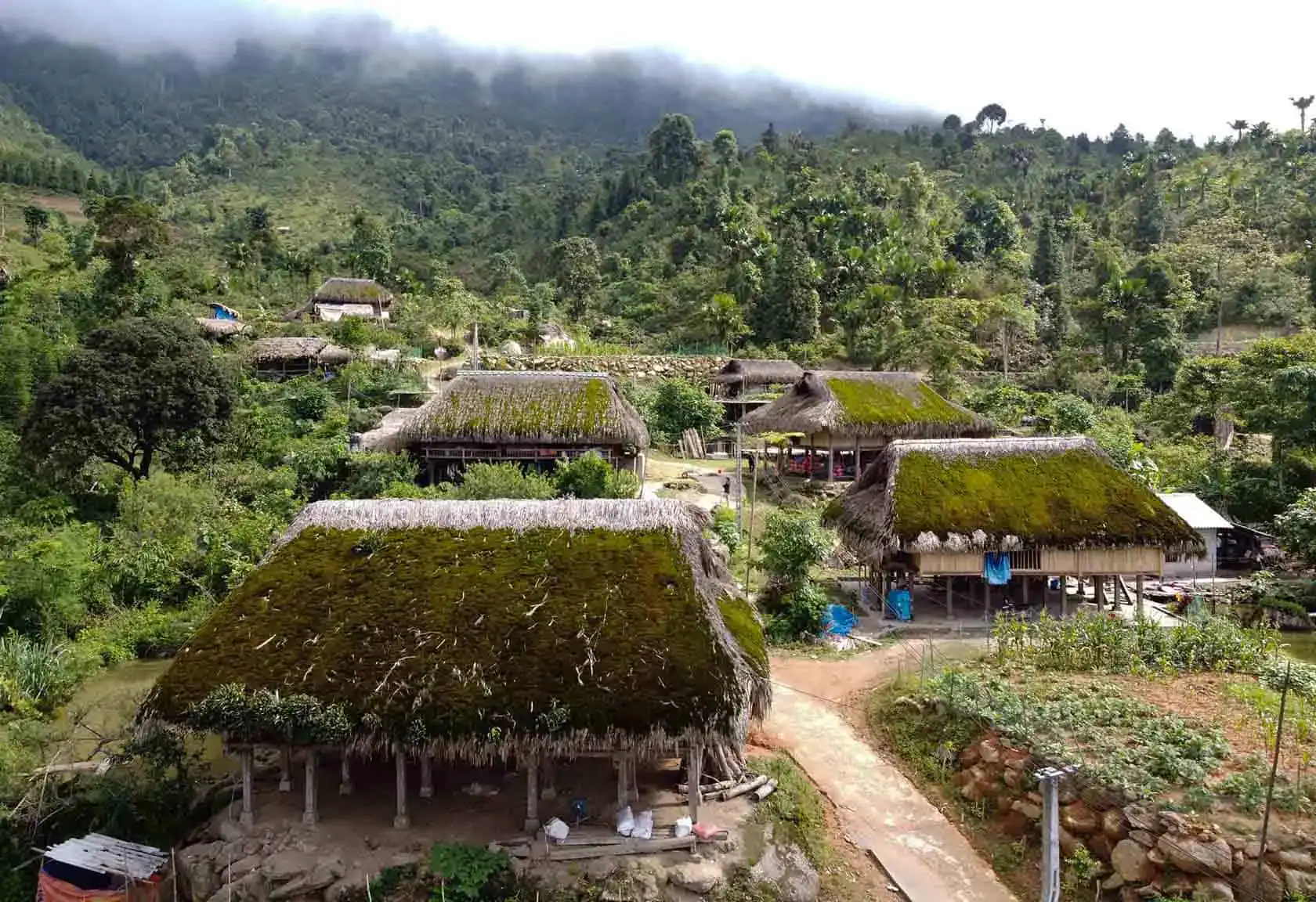
Traditional Dao Ao Dai architecture centers on elevated stilt houses built from mountain hardwoods, woven bamboo walls, and palm-thatched roofs. In high hamlets like Xa Phin mossy roof village, mountain humidity encourages thick emerald moss to blanket palm thatch, providing natural thermal insulation.
A classic stilt house stands 1.5 to 2.5 meters above the hillside on wooden pillars. The open ground level shelters farm equipment and firewood, keeping living quarters dry. Hand-hewn stairs lead to an open veranda where women dry herbs, sort tea leaves, and receive neighbors.
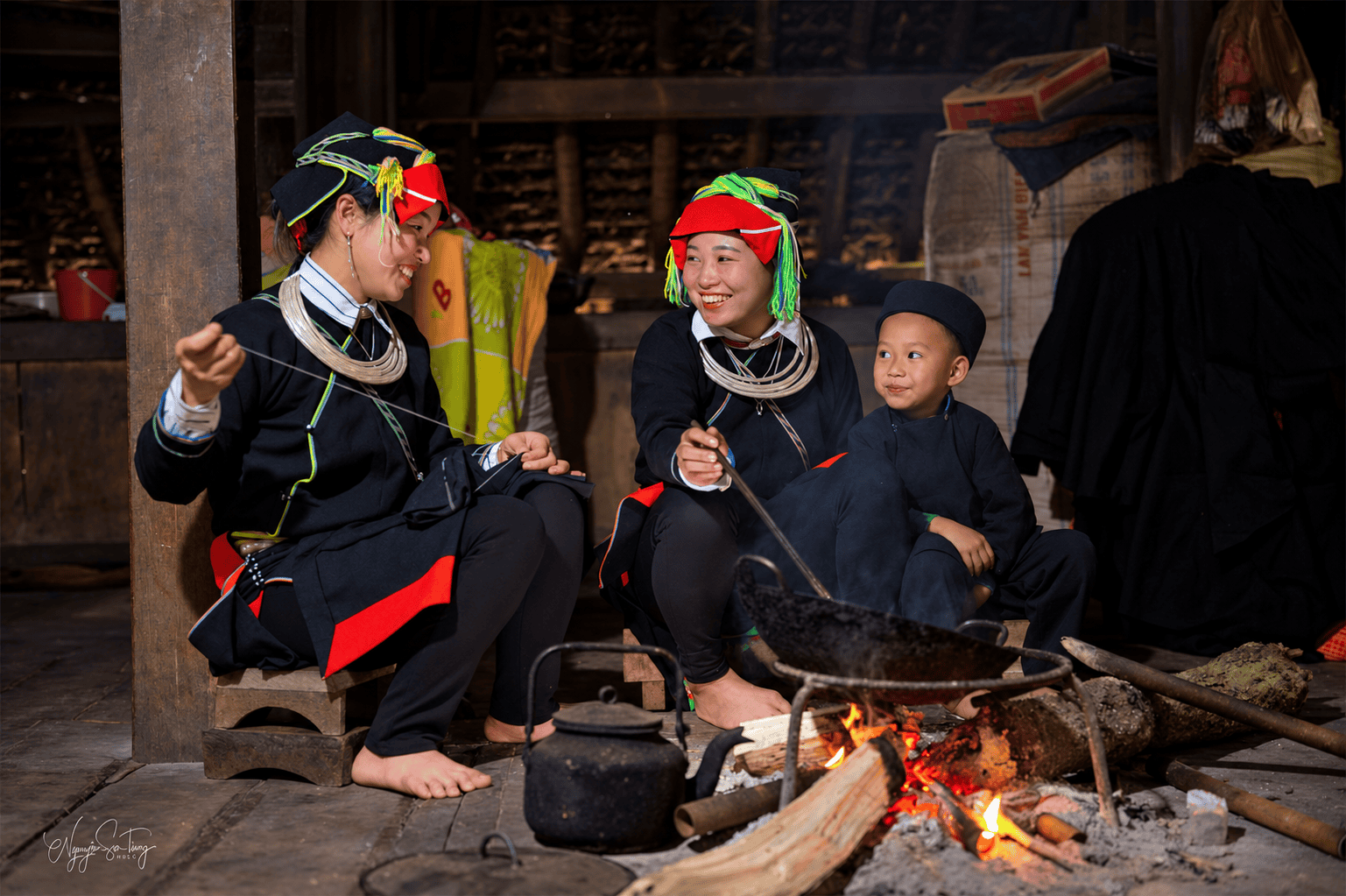
Inside, the wood-fired hearth (bep lua) forms the domestic core of daily life. Family members gather around coals to cook meals, boil water, and welcome guests. Overhead, a bamboo rack (gat bep) holds cuts of pork, river fish, and seed corn curing slowly in hardwood smoke for winter storage.
The hearth carries strict domestic taboos:
- Never step over the hearth frame or fire stones.
- Avoid pointing feet directly at the flames while seated on mats.
- Never throw plastic waste, wrappers, or rubbish into the fire.
Spiritual Beliefs, Ancestral Worship and the Cap Sac Rite
Spiritual life among the Dao Ao Dai combines ancestral veneration for progenitor Ban Vuong with traditional Taoist cosmological principles. In every home, the ancestral altar occupies the central wall above head height. Families present offerings of mountain tea, rice wine, and sticky rice cakes on lunar milestone days and during seasonal festivals.
Ceremonial rites are led by village ritual masters (thay cung) who preserve handwritten books in Nom Dao script recording family lineages, healing rituals, and prayers for healthy crops.
The central cultural milestone for every Dao Ao Dai male is the Cap Sac ceremony (spiritual coming-of-age ritual). A man without Cap Sac is not recognized as a spiritual adult, cannot lead ancestral prayers, and traditionally cannot marry.
- Cap Sac Level 3 (3 Lamps): Baseline ordination for young men aged 12 to 18, conferring adult spiritual status and a formal Nom Dao name.
- Cap Sac Level 7 (7 Lamps): Intermediate ordination for mature men assisting ritual masters during communal ceremonies.
- Cap Sac Level 12 (12 Lamps): The highest spiritual rank, reserved for senior masters qualified to conduct major community rituals.
During this multi-day ritual, spiritual masters guide the inductee through moral teachings, requiring vows of honesty, respect for elders, and mutual village support.
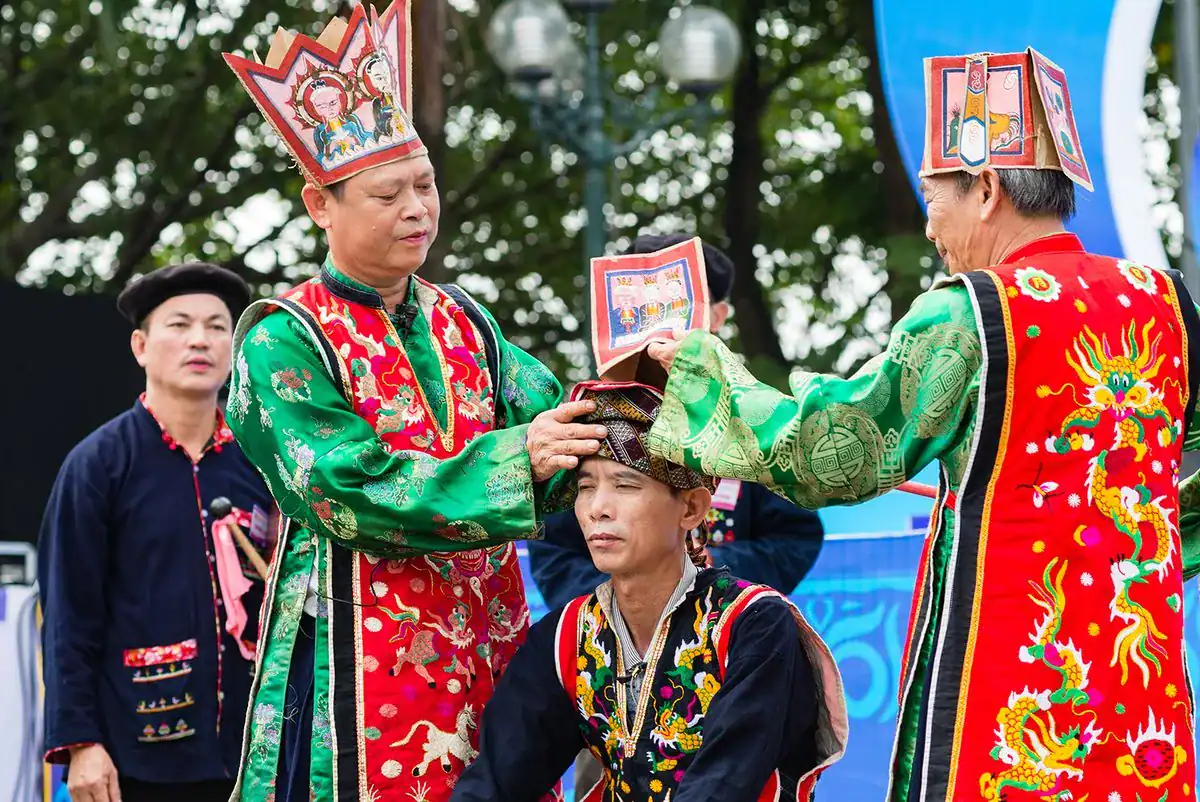
The Cap Sac ceremony provides a foundational moral framework, fostering honesty, civic responsibility, and communal solidarity across generations on Mount Tay Con Linh.
Ancient Shan Tuyet Tea and Mountain Livelihoods
The primary agricultural livelihood of the Dao Ao Dai on Mount Tay Con Linh is cultivating ancient Shan Tuyet tea (Camellia sinensis var. assamica).
These heirloom trees grow between 800 and 1,400 meters above sea level, reaching heights of 6 to 12 meters with trunk circumferences exceeding 1 meter. Many specimen trees are between 100 and 300 years old.
Dao farmers climb directly into the branches of ancient Shan Tuyet tea trees to harvest young shoots coated in silvery white fuzz. Freshly picked leaves undergo careful artisanal processing in village homes:
- Leaf Selection: Harvesters sort tender buds on round bamboo trays.
- Iron Wok Roasting: Leaves are pan-fired in iron woks over hardwood fires to halt oxidation.
- Hand Rolling: Hot leaves are rolled on bamboo mats to release aromatic oils.
- Charcoal Drying: Leaves dry over slow embers until crisp, producing an amber liquor with sweet honey notes.
Beyond tea harvesting, households cultivate terraced wet-rice fields along steep ravines, grow mountain corn, and manage watershed forests under customary conservation rules.
Traditional Ethnobotany and Home Wellness
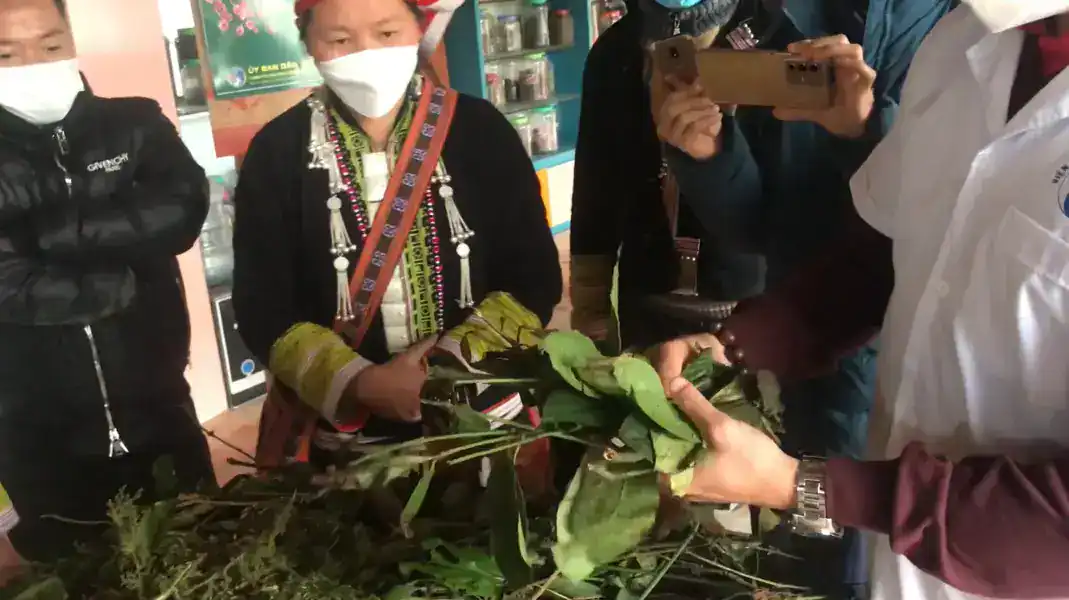
Ethnobotanical lore among the Dao Ao Dai is a domestic matrilineal tradition centered on wild medicinal plants gathered from the primary forests of Mount Tay Con Linh. Mothers instruct daughters in identifying seasonal leaves, wild ginger roots, and medicinal barks during foraging walks in surrounding forests.
Within Dao Ao Dai households, these forest plants serve practical restorative purposes:
- Hearthside Herbal Foot Baths: After long days tending steep rice terraces or guiding mountain treks, families boil aromatic leaves and wild barks in iron kettles. The warm decoction is poured into wooden tubs for foot soaks to ease fatigue and restore circulation.
- Postpartum Herbal Tonics: Following childbirth, Dao mothers prepare boiled root extracts to warm the body, stimulate digestion, and help new mothers regain physical vitality.
- Seasonal Herbal Brews: Freshly gathered forest leaves are steeped as light table infusions to refresh the body and soothe coughs during damp winter months.
Unlike commercial spa operations in lowland towns, herbal care here remains a private family tradition. Visitors can appreciate this heritage by observing herbs on verandas and drinking forest tea by the hearth.
Responsible Travel and Village Etiquette Checklist
- Remove Footwear Indoors: Leave boots and trekking shoes at the entrance before stepping onto wooden floors.
- Sit Respectfully: Tuck feet beneath you or sit cross-legged; never point feet toward the household ancestral altar.
- Ask Before Taking Photos: Politely ask permission before photographing village elders, artisans at work, or children in hamlets.
- Observe Hearth Rules: Do not cross over hearth boundaries or burn trash in domestic fireplaces.
- Receive Cups with Two Hands: Accept tea or hospitality drinks using both hands as a gesture of courtesy.
- Respect Sacred Items: Never touch ritual headdresses, silver torcs, or Nom Dao manuscripts without invitation.
- Book Private Local Guides: Choose 100% private tailor-made walking tours led by licensed local guides who understand community etiquette and local Dao customs.
Frequently Asked Questions About the Dao Ao Dai
Where are the best Dao Ao Dai villages to visit in Ha Giang?
The most authentic Dao Ao Dai villages lie on Mount Tay Con Linh in Ha Giang province. Khuoi My village and Xa Phin mossy roof village feature palm-thatched stilt houses with green moss, ancient tea forests, and cascading rice terraces. Travelers can visit on private guided hikes from TVPalm Ecolodge or day walks from Ha Giang city.
What makes Dao Ao Dai traditional clothing distinctive?
Dao Ao Dai traditional dress is characterized by an ankle-length indigo tunic with long side vents, worn over dark indigo trousers and secured with a hand-embroidered sash.
Unlike the bright crimson pom-poms of the Red Dao, Dao Ao Dai attire features understated indigo headdresses, fine geometric collar stitching, and hand-hammered silver torcs that symbolize family protection and spiritual identity.
How can travelers support the Dao Ao Dai sustainably?
Travelers can support communities by booking 100% private tailor-made trekking tours led by local guides from Khuoi My and Xa Phin. Buying Shan Tuyet tea directly from growers, following village etiquette, and staying at TVPalm Ecolodge keeps benefits in the mountain community.
Written by Nguyễn Văn Trung, founder of TVPalm. He has led small-group trips across Northeast Vietnam since 2021.


