

Shan Tuyet tea in Tay Con Linh is crafted entirely by hand in family kitchens rather than industrial factories. As founder of TVPalm, I have spent years walking the ancient tea forests with indigenous Dao Ao Dai families around Mount Tay Con Linh (2,428 m).
See the trees yourself. The 1-day ancient Shan Tuyet tea trek takes you to them, and the 3-day Tay Con Linh trek walks through the tea villages on the way to the summit.
In this guide, I break down the five core steps of traditional green tea processing, explain how three distinct teas come from a single leaf, and provide practical brewing parameters to experience authentic high-mountain character.
From ancient trees to fresh harvest
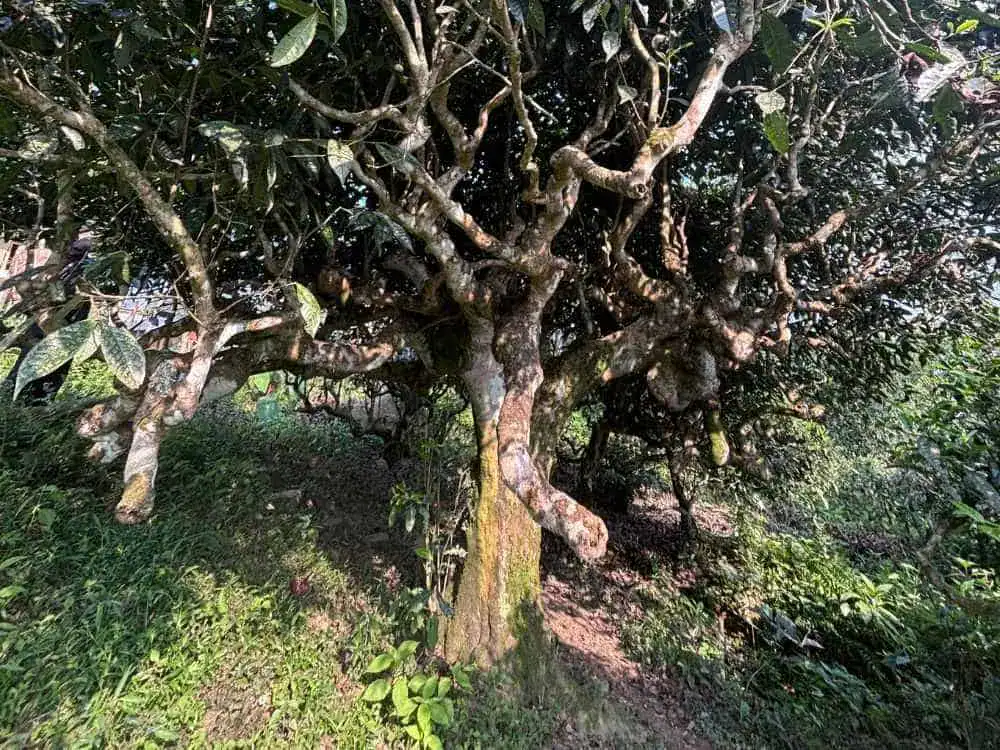
Harvesting ancient Shan Tuyet tea requires climbing wild, century-old trees to hand-pick tender buds blanketed in protective white down. Unlike commercial tea estates where shrubs are trimmed into waist-high rows, ancient trees on Mount Tay Con Linh grow naturally into forest giants standing 5 to 15 meters tall.
The oldest specimens thrive in primary montane forests between 600 and 1,600 meters elevation, nourished by daily cloud cover, heavy rainfall, and mineral-rich highland soils. Groups of these trees in Ha Giang are recognized as Vietnamese Heritage Trees, and Shan Tuyet tea from this region holds a protected national geographical indication.
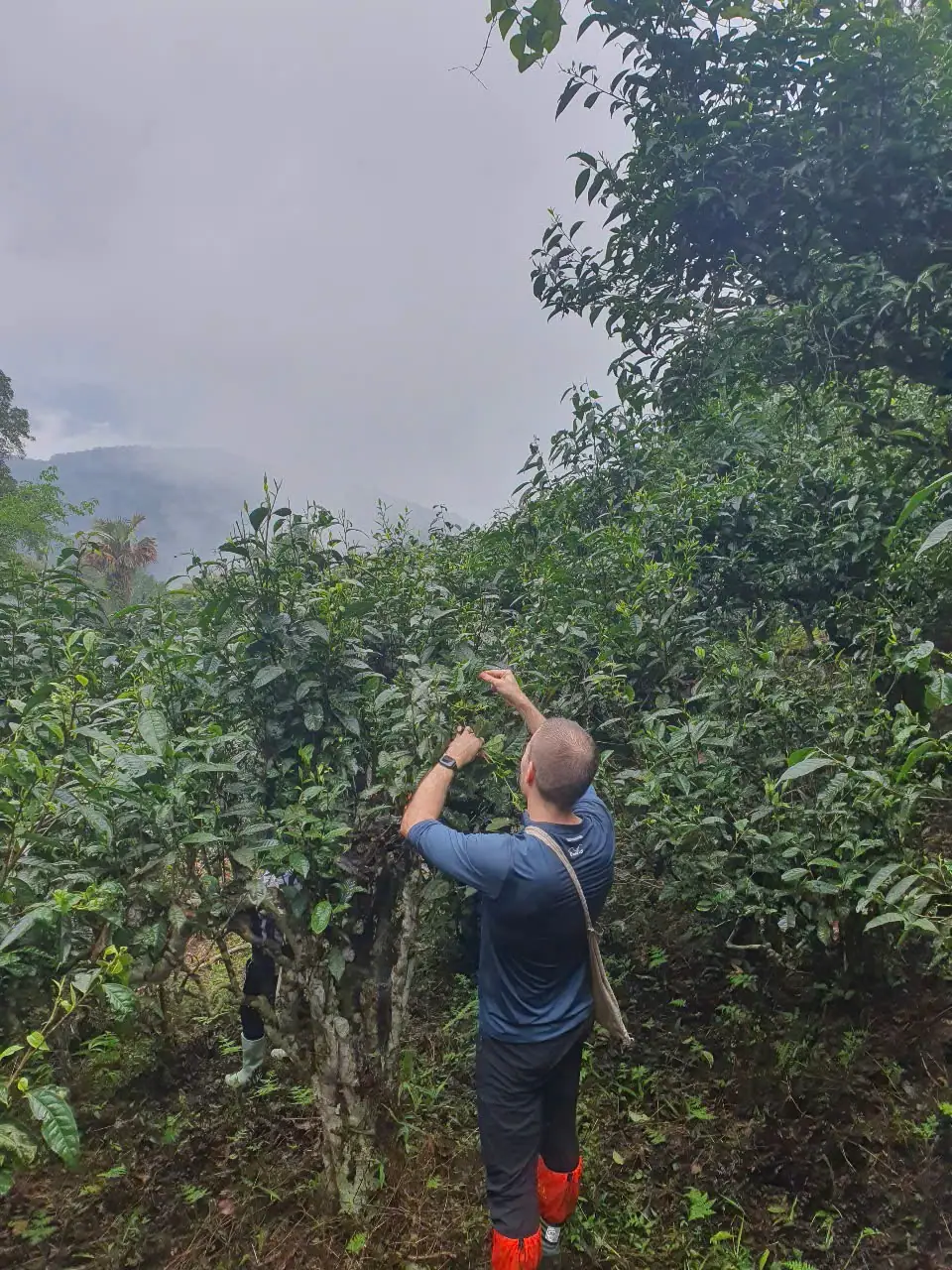
Indigenous Dao Ao Dai villagers from settlements such as Na Thac and Khuoi My climb directly into sturdy upper branches to gather spring flushes. Harvesting begins in early morning mist to ensure the foliage remains cool and hydrated. Three strict standards govern how local artisans gather leaves before lighting any fire:
- Selective shoot harvesting: Harvesters select one young terminal bud paired with one or two tender leaves. The dense white trichome hairs covering the bud protect young shoots from frost and give the tea its signature snow (tuyết) designation.
- Dry morning collection: Pickers avoid harvesting during persistent heavy rain. Excess surface water complicates temperature management in the roasting wok and dilutes volatile essential oils.
- Gentle basket handling: Freshly gathered shoots rest loosely in woven bamboo baskets. Compacting or compressing the harvest bruises leaf tissue and initiates uncontrolled early oxidation.
5 core steps of artisanal tea crafting
1. Selective hand-picking
Harvesting wild alpine tea requires agile climbing into ancient forest crowns between dawn and mid-morning. Artisans select only intact shoots adhering strictly to the traditional standard of one terminal bud with one or two adjacent tender leaves.
Collecting leaves while early mist cloaks the slopes prevents dehydration from direct sunlight and preserves fragile white trichome hairs.
2. Natural ambient withering
Fresh harvest spreads thinly across round bamboo trays set in well-ventilated, shaded rooms. During this 2 to 4 hour resting period, leaves gently release 15% to 25% of their surface moisture.
The foliage softens, becomes supple for high-heat manipulation, and sheds its raw vegetal sharpness in favor of delicate floral aromas without initiating premature enzymatic oxidation.
3. Cast-iron wok pan-firing and enzyme deactivation
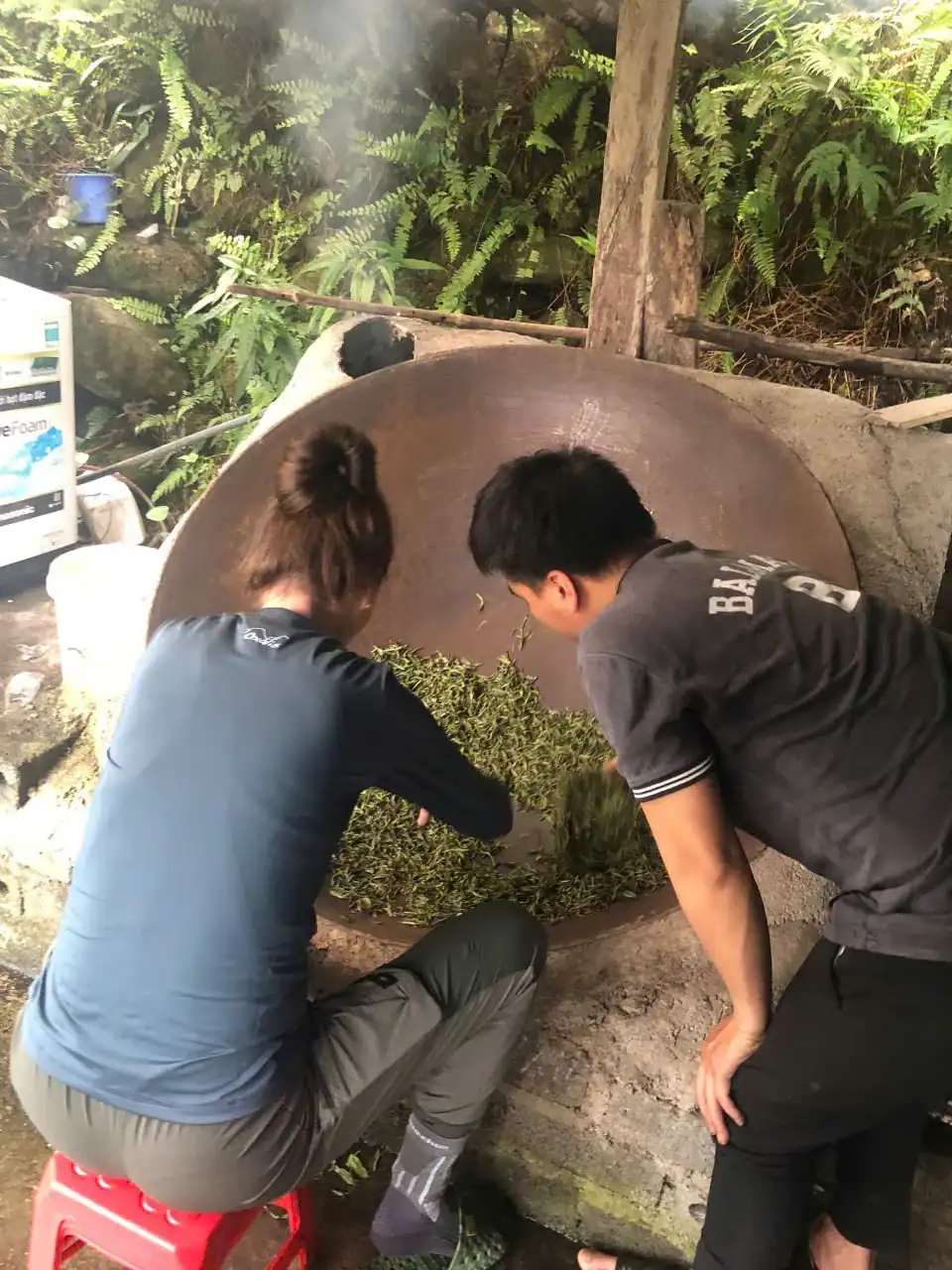
Immediate thermal deactivation is vital for authentic green tea. Artisans toss withered leaves into a concave cast-iron wok heated between 180°C and 200°C over a hardwood fire.
This process, known locally as diệt men (kill-green), permanently halts polyphenol oxidase enzymes within 5 to 7 minutes, preventing leaf browning and locking in natural catechins, essential vitamins, and vivid emerald liquor color.
4. Manual palm-rolling on woven bamboo
While the pan-fired leaves remain hot and supple, the tea maker transfers them to coarse bamboo trays. Using firm, rhythmic palm pressure, the maker rolls the batch in continuous concentric circles for 10 to 15 minutes.
This twisting motion breaks internal cell membranes, draws aromatic essential oils to the outer leaf surface, and curls the shoots tightly without shearing delicate white trichomes.
5 Wood-fire drying and aroma finishing
| Processing Stage | Crafting Mechanism | Thermal and Time Parameters | Primary Quality Impact |
|---|---|---|---|
| Selective Harvesting | Manual canopy climbing and one-bud-two-leaf picking | Early morning mist (6:00-9:00 AM) | Protects delicate trichomes; guarantees peak morning hydration |
| Ambient Withering | Shaded ventilation on flat bamboo trays | 2-4 hours at ambient mountain temperatures | Reduces leaf moisture by 20%; softens tissue for wok firing |
| Cast-Iron Pan-Firing | Continuous manual tossing in cast-iron wok (diệt men) | 180-200°C for 5-7 minutes | Deactivates oxidising enzymes; preserves natural catechins and green hue |
| Manual Palm-Rolling | Circular palm friction on textured bamboo mats | 10-15 minutes while leaves remain warm | Ruptures essential oil cells; forms signature twisted curls |
| Wood-Fire Finishing | Slow charcoal ember dehydration and final aroma roasting | 70-85°C until moisture drops below 5% | Guarantees microbial stability; yields toasted honey fragrance and white down |
“In traditional Dao Ao Dai kitchens on Mount Tay Con Linh, tea processing is an unhurried, generational craft. What you taste in the cup is a direct reflection of morning mountain mist, wood fire built at dawn, and the patient touch of local artisans who shape every single curl by hand.”
3 distinct teas from a single leaf
- White Tea (Bạch Trà) – Non-oxidized & Unfired: Crafted exclusively from single unopened terminal buds harvested in early spring. Buds undergo gentle ambient withering on shaded racks followed by slow, low-temperature sun or air drying. White tea bypasses wok pan-firing and rolling entirely, preserving whole trichome down and yielding floral, pale amber infusions.
- Green Tea (Lục Trà) – Enzyme-deactivated: Produced through the five-step artisanal sequence above. High-heat pan-firing immediately deactivates polyphenol oxidase enzymes, followed by warm palm-rolling and charcoal finishing. The liquor remains golden emerald with a crisp mineral backbone and profound sweet finish (hậu ngọt).
- Red Tea (Hồng Trà) – Fully Oxidized: Harvested buds and leaves undergo deep withering, followed by vigorous hand-rolling without prior pan-firing. Because oxidising enzymes remain active, rolled leaves rest in humid, shaded wicker baskets for 3 to 6 hours. Atmospheric oxygen oxidizes catechins into rich theaflavins and thearubigins, turning foliage coppery red. High-heat roasting then halts oxidation, locking in malty, cocoa, and ripe stone-fruit aromas.
6 Ways to Brew and Enjoy Ancient Shan Tuyet Tea
- 1. Pure Spring or Filtered Water: Use fresh mountain spring water or filtered soft water. Clean, odor-free water lets the tea’s delicate wildflower aroma and natural sweetness shine without harshness.
- 2. Gentle Water Temperature: Never pour rolling boiling water directly onto delicate tea buds. Let freshly boiled water rest for a moment: 80–85°C for white tea, 85–90°C for green tea, and 90–95°C for red tea.
- 3. Warm the Teapot and Cups: Rinse your teapot and small tasting cups with hot water first. Warming the teaware awakens the dry leaves and releases their aroma the moment they enter the pot.
- 4. Traditional Tea-to-Water Ratio: Place 5 to 7 grams of whole dried tea leaves into a standard 150 ml teapot. Ancient wild buds expand generously as they unfurl in hot water.
- 5. Quick Steeping Times: Steep for only 20 to 30 seconds on the first rounds instead of leaving leaves to soak. Ancient Shan Tuyet leaves yield 6 to 10 consecutive rounds, growing sweeter with every pour.
- 6. Decant Completely and Savor: Pour all tea liquor out into a sharing pitcher (chén tống) before serving into tasting cups to prevent bitterness. Savor each sip slowly to feel the silky texture and deep, lingering sweetness (hậu ngọt).
Storage tip: Keep your dry tea in a sealed ceramic caddy or airtight tin away from sunlight, moisture, and strong kitchen aromas to preserve peak freshness.
Frequently asked questions
Why is it called Shan Tuyet, or snow tea?
The name originates from the dense coating of silvery-white downy hairs (trichomes) covering the bud and young leaves. In Vietnamese, tuyết translates to snow, while shan refers to high mountain slopes. The white fluff remains visible on finished green and white teas, signaling authentic alpine origin.
Why do local makers pan-fire in a cast-iron wok instead of steam-fixing?
Cast-iron wok roasting creates direct dry contact heat that caramelizes natural leaf sugars, imparting a distinct toasty, nutty fragrance characteristic of Northeast Vietnamese tea. Steam-fixing, widely used in Japan, produces grassier, vegetal flavors but lacks the subtle smoky profile favored by Dao artisans.
How long does hand-processed Shan Tuyet tea keep fresh?
When stored in sealed, light-proof tins away from humidity, green and white Shan Tuyet teas maintain peak freshness for 12 to 18 months. Red tea and naturally aged batches remain stable for several years, gradually developing deeper dried-fruit aromas without spoiling.
Written by Nguyễn Văn Trung, founder of TVPalm. He has organized responsible community-based trekking expeditions across Northeast Vietnam since 2021.


