

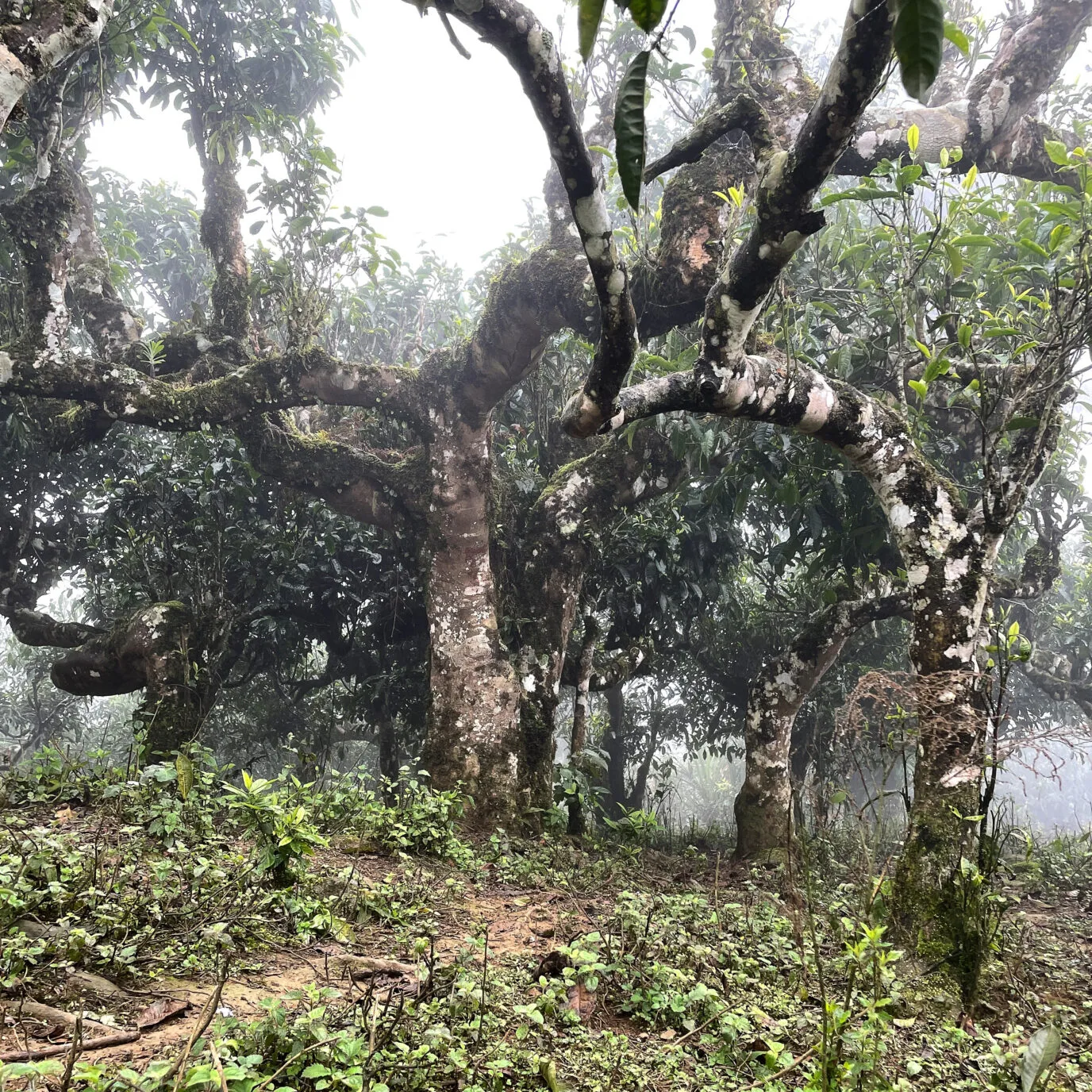
On the eastern slopes of Tay Con Linh grow tea trees that are older than anyone in the village, and older than the village itself. They are not bushes cut to waist height. They are trees, some taller than a house, covered in moss, and the Dao Ao Dai families who look after them say the eldest are close to a thousand years old.
At TVPalm, we walk to these trees with families from Khuoi My, Na Thac and the villages around Cao Bo, who have tended them for generations.
I am Nguyễn Văn Trung, founder of TVPalm. In this guide I share what we know about these trees: what they are, how families harvest and make the tea, how to drink it, and how to visit with respect.
What are ancient Shan Tuyet tea trees?
Shan Tuyet trees are old, seed-grown tea trees (Camellia sinensis) native to the mountains of northern Vietnam, from around 600 m up into the cloud forest. Botanists still debate exactly how to classify them; Vietnamese studies call them var. shan, others place them close to var. assamica.
Unlike plantation bushes, they are allowed to grow into real trees, with thick trunks and wide crowns. Nobody fertilises them; they live off the forest soil around them.
Shan Tuyet means “snow mountain”. Shan is the mountain; tuyet is the silvery-white down that covers every young bud, as if dusted with snow.
That down is made of fine plant hairs. It protects the young bud from cold and strong light in the mountains.
The white down, and the mountain climate
The down stays white when the tea is dried, which gives good Shan Tuyet its frosted look. In the cup, it gives the liquor a slight shimmer.
The climate on Tay Con Linh is wet and misty, with heavy rain for much of the year. Moss and ferns grow on the bark of the old trees.
Cool nights and slow growth are part of why the leaf is so rich. Scientific studies of Ha Giang’s Shan trees have found larger leaves, thicker buds and a strong profile of polyphenols and catechins compared with ordinary tea.
Ancient forest trees and lowland plantation tea, compared
The differences go beyond taste: roots, soil, biodiversity and how people live with the trees.
| Agronomic Feature | Ancient Shan Tuyet Trees (Tay Con Linh) | Lowland Plantation Tea (Industrial) |
|---|---|---|
| Botanical Variety | Camellia sinensis (Shan tea; classification still debated) | Camellia sinensis var. sinensis |
| Tree Lifespan | Hundreds of years (some rare trees up to 1,000) | 15 to 30 years (commercial replanting) |
| Tree Height | 6 to 15 meters (requires tree-climbing) | 0.8 to 1.2 meters (mechanically pruned) |
| Growing Elevation | From about 600 m up into the cloud forest | 100 to 600 meters above sea level |
| Chemical Inputs | Zero fertilizers or chemical pesticides | Frequent synthetic fertilization & sprays |
Tay Con Linh’s old tea grows near quiet villages of stilt houses. For more of them, see our guide to peaceful villages in Ha Giang.
Climbing to harvest, and making tea over a wood fire
Picking old Shan Tuyet tea is skilled, physical work, passed down in Dao Ao Dai and Hmong families. On tall trees, the young buds grow high up, so pickers climb.
They climb the mossy branches barefoot or in thin rubber shoes, and pick the shoots one by one.
How the Dao Ao Dai pick the tea
Families follow simple rules that keep the trees healthy:
- Early in the morning: picking starts early, while the mist is still in the trees.
- One bud and two leaves: only the closed bud and the two young leaves below it (mot bup hai la), so the older leaves keep feeding the tree.
- By hand, never with shears: the shoot is pinched off between thumb and finger.
- Open bamboo baskets: fresh leaves go straight into open-weave baskets so they stay cool.
Pan-firing over wood, and drying
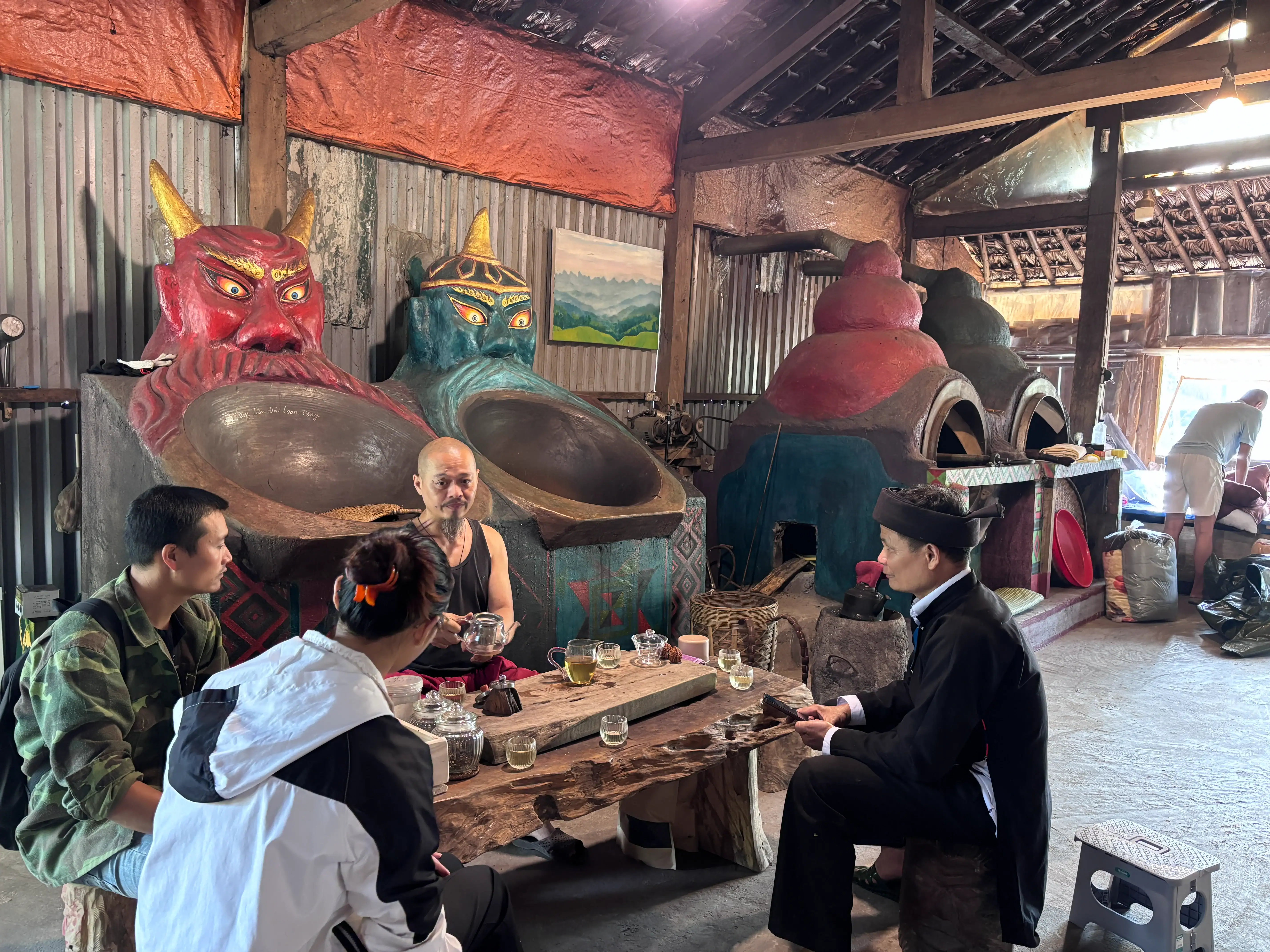
The leaves are processed the same day. In the Dao Ao Dai villages of Khuoi My, Na Thac and Cao Bo, families use big iron pans over wood fires. There are four steps:
- Withering: the leaves rest in the shade on bamboo trays to lose some moisture.
- Pan-firing: the leaves are tossed by hand in a very hot pan to stop oxidation.
- Rolling: still warm, they are rolled by hand on bamboo mats to twist them.
- Drying: they go back over gentle heat until they are completely dry, to keep the aroma.

Tasting, brewing, and visiting the tea with TVPalm
Good old-tree Shan Tuyet brews a clear golden liquor that smells of honey, hay and wild flowers. There is a light bitterness at first, then a long sweetness that stays in the throat.
Well made and dry, it keeps well, which makes it one of the best Ha Giang specialities to take home.
How to brew it
To bring out the aroma without scalding the downy buds:
- Teaware Selection: Use a non-porous glazed porcelain gaiwan or purple clay yixing teapot (120 ml to 150 ml capacity) preheated with boiling water.
- Leaf-to-Water Ratio: Weigh 5 to 6 grams of dry whole leaf for 120 ml of filtered spring water (approximately 1:20 ratio).
- Water Temperature: Heat fresh water to 85°C to 90°C. Never pour rolling 100°C boiling water directly onto dry buds, as excessive heat burns delicate leaf hairs and creates unwanted harshness.
- Flash Rinse: Pour water gently along the gaiwan rim and decant immediately (within 3 seconds) to awaken the leaves and release bouquet aromatics.
- Short Infusions: Steep for 15 to 20 seconds on the first infusion. Add 5 to 10 seconds for each subsequent brew. High-grade ancient Shan Tuyet yields 8 to 12 distinct infusions without losing structural sweetness.
A cup of fresh Shan Tuyet by the fire after a day of walking is part of village life. For homestay customs and family dinners, read our guide to the homestay experience in Ha Giang.
Visiting the old tea with TVPalm
Our tea walks start from TVPalm Ecolodge, near Khuoi My, at the foot of Tay Con Linh. You stay in a private room, eat what the farm and the valley grow, and walk with the families who look after the trees.
Our view: under an old Shan Tuyet tree in the morning mist, you understand that tea here is not a crop like any other. These trees were kept, not cut, by people who knew what they were worth.
Nguyễn Văn Trung, Founder, TVPalm
Our one-day Na Thac walk climbs about 3.25 km from the village gate at 379 m to an old tea garden at 609 m, then spends most of the day in a Dao Ao Dai home, taking your own leaf from picking to drying. In community-based tourism in Ha Giang, what you pay goes directly to the families who host you.
For longer trips, our Tay Con Linh treks link the old tea paths with the cloud forest and the summit.
Ancient Shan Tuyet tea trees: common questions
How old are the oldest Shan Tuyet trees in Ha Giang?
Many are several hundred years old. In Cao Bo, on the slopes of Tay Con Linh, a group of 220 trees between 100 and 300 years old was recognised as Vietnam Heritage Trees; in 2022, another 1,324 old Shan Tuyet trees across Ha Giang (part of Tuyen Quang province since July 2025) received the same title. Local families say the very eldest are close to a thousand years old.
The Vietnam Heritage Tree title, given by the Vietnam Association for Conservation of Nature and Environment (VACNE), honours wild trees over 200 years old and planted trees over 100.
When is the best time to visit the tea?
Spring, from late March to early May, when the trees put out their first buds after winter.
The spring tea is the most prized. There is a second picking in autumn, from September to October, with clear weather, golden rice terraces and tea being roasted in the villages.
How much caffeine is in Shan Tuyet tea?
Like other teas, it contains caffeine, generally less per cup than coffee. The exact amount depends on the leaf and how you brew it.
Tea also contains L-theanine, which many drinkers find gives a calmer kind of alertness than coffee.
Want to walk it yourself? See our 3-day Tay Con Linh trekking tour.


