

Dong Van is the stone heart of the Ha Giang Loop: a small market town at about 1,000 m, inside the Dong Van Karst Plateau UNESCO Global Geopark, more than 2,350 km² of limestone mountains and deep canyons.
By the time you reach it, you have crossed Quan Ba Heaven Gate and Tham Ma Pass. Dong Van gives you an old quarter of clay-walled houses, the Vuong family palace, and the road to Ma Pi Leng and Lung Cu.
What is Dong Van, and why does it matter?
Dong Van is a market town about 150 km north of Ha Giang City on Highway 4C. It is the last town before Ma Pi Leng Pass and the base for Lung Cu, Vietnam’s northernmost point, about 24 km further north. Since July 2025, it lies in Tuyen Quang province, after the merger with Ha Giang.
The town sits inside the Dong Van Karst Plateau Geopark, recognised by UNESCO’s Global Geoparks Network on 3 October 2010, and re-recognised in 2014, 2019 and 2023.
The geopark covers the former districts of Dong Van, Meo Vac, Yen Minh and Quan Ba. Its rocks record more than 500 million years of Earth’s history, from the Cambrian onward, including traces of two of the great mass extinctions, at the end of the Devonian and at the end of the Permian. Geologists have described over a hundred geological heritage sites here.
It was Vietnam’s first UNESCO Global Geopark and the second in Southeast Asia. Unlike a national park, a geopark protects rocks, landscapes and the culture of the people who live there together, and about 17 ethnic groups share the plateau.
What to see in and around Dong Van
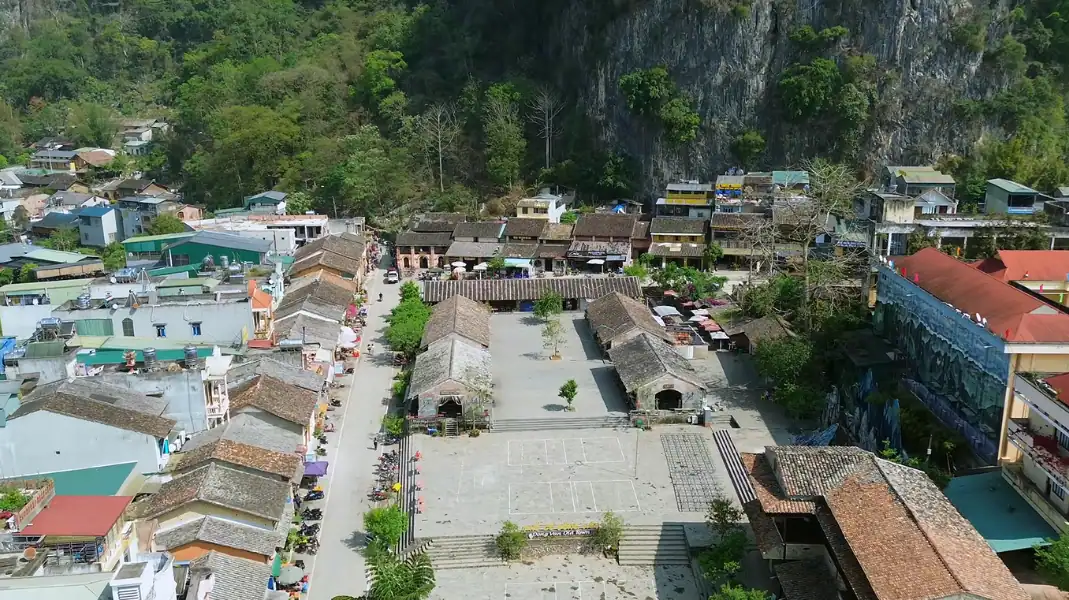
Dong Van old quarter
The old quarter grew between the late 19th century and the 1930s as a trading place for Hmong, Tay, Hoa and Yunnanese merchants. Around 40 old houses survive, and the quarter is protected as a national heritage site.
- The houses: two storeys, thick rammed-earth walls, pine-wood frames and curved clay roof tiles.
- Size: a small area at the bottom of the valley, easy to walk in an hour.
- When to go: between 06:00 and 08:00, before the groups arrive, when the low light hits the walls and the tiles.
- Sunday market: every Sunday morning, families from the villages come to trade livestock, cloth, herbs and produce. Go early.
The Vuong family palace (the “Hmong King’s palace”)
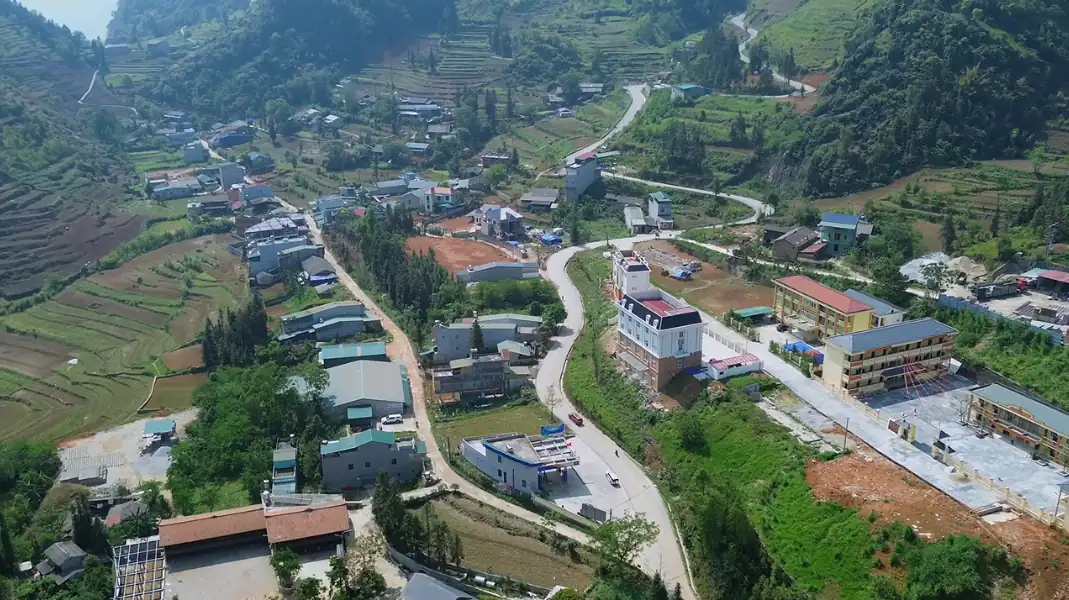
The Vuong palace (Dinh Vuong) stands in the Sa Phin valley, about 15 km west of Dong Van. It was built between 1919 and 1928 for Vuong Chinh Duc, the Hmong leader who ruled the area under French rule.
| Specification | Value |
|---|---|
| Construction period | 1919 to 1928 (9 years) |
| Total area | 1,120 square meters |
| Room count | 64 rooms across three sections |
| Building materials | Green schist stone, pine wood, terracotta tiles |
| Architectural influences | Chinese courtyard house, French colonial, Hmong stone masonry |
| Distance from Dong Van | 15 km (35 minutes by motorbike) |
| Entrance fee | 20,000 VND per adult |
It has three courtyards, front, middle and back, inside a stone wall. The back section held the family’s private rooms, and an old opium store is kept as part of the history of the place.
Lung Cu Flag Tower
Lung Cu Flag Tower stands near Vietnam’s northernmost point, on Dragon Mountain (Long Son) at about 1,470 m. The tower is about 33 m tall, and a 54 m² flag flies from the top.
- Getting up: around 389 stone steps from the car park, then a spiral staircase inside the tower.
- The view: north into Yunnan, China, and south over the karst plateau.
- Permit: Lung Cu is in the border area, so you need the border permit. TVPalm arranges it for every guest.
- From Dong Van: about 24 km north, roughly 50 minutes by road.
Ma Pi Leng Pass and the Nho Que River
Ma Pi Leng starts a few kilometres southeast of Dong Van and runs about 20 km to Meo Vac. The road is cut into the cliff, up to about 1,500 m, above Tu San Canyon, where the Nho Que River runs 700 to 800 m below.
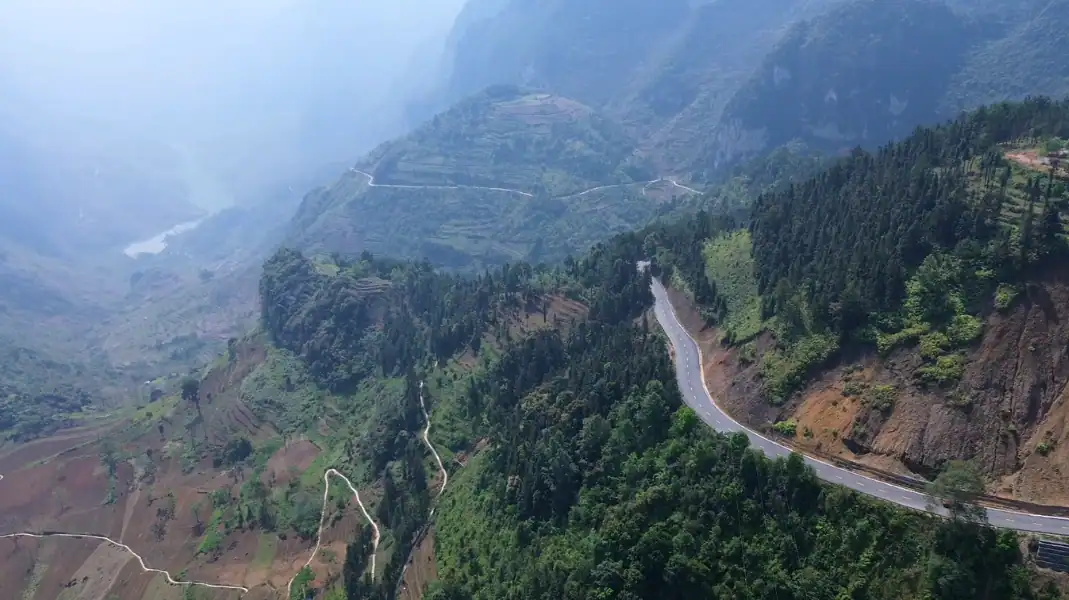
- White Cliff path: a footpath of about 3 km cut into the cliff near the top of the pass, about 90 minutes there and back. There are no barriers on the cliff sections; stay well back from the edge.
- Boat on the Nho Que: from the Meo Vac side, a short motorboat trip up the green river between the canyon walls. Prices change; ask on the day.
When to visit Dong Van
| Season | Months | Key Feature | Road Conditions |
|---|---|---|---|
| Buckwheat Flower Season | October to December | Pink and white fields cover the plateau | Excellent – dry roads |
| Rice Harvest Season | September to October | Golden terraced fields in valley bowls | Good – occasional fog |
| Spring Blossom Season | January to March | Peach, plum, and red bombax flowers | Cold – possible frost above 1,200m |
| Green Season | April to June | Vivid green landscape after rains | Wet – watch for landslides |
| Rainy Season | July to August | Heavy monsoon rains | High landslide risk – not recommended |
Our choice: October. The first buckwheat flowers, the end of the rice harvest in the lower fields, and usually dry roads. Expect about 14°C at night and up to 26°C in the middle of the day.
Getting to Dong Van from Ha Giang City
The usual route follows Highway 4C for about 150 km, the main section of the loop. Allow 4 to 6 hours with stops.
- Quan Ba (km 45): Heaven Gate and the Twin Mountains, 30 minutes.
- Yen Minh (km 100): lunch in town, 45 minutes.
- Tham Ma Pass (km 130): nine hairpins and a view over the karst, 20 minutes.
- Dong Van (km 150): check in before dark.
TVPalm runs easy rider tours only: a local rider does the driving, and you look at the landscape. We do not rent motorbikes or sell self-drive trips. See our Ha Giang easy rider tours guide for details.
Where to stay and eat in Dong Van
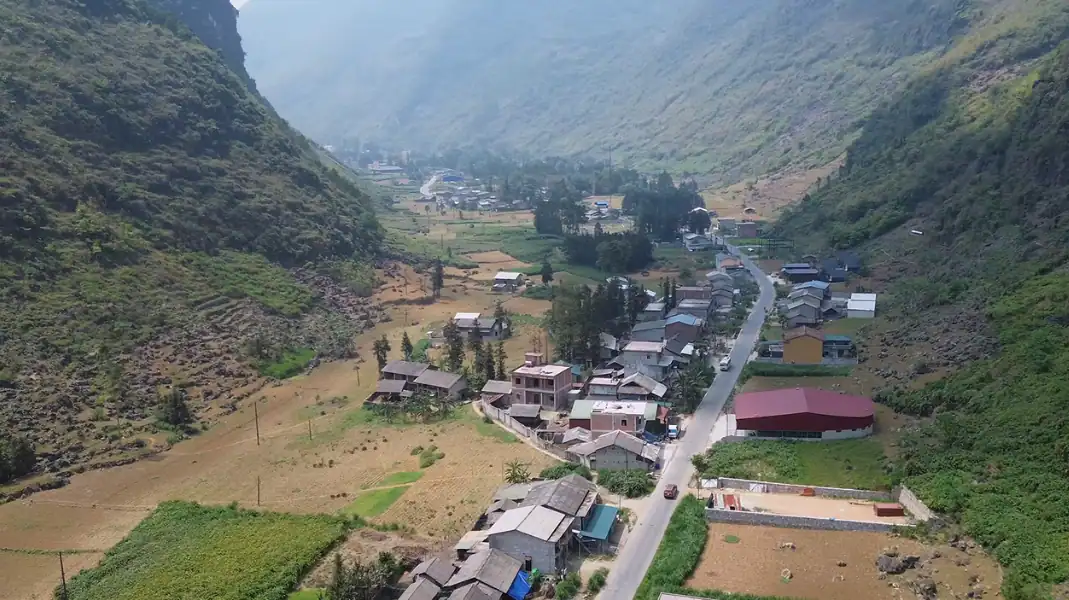
- Where to stay: the town has a good choice of guesthouses and homestays with private rooms. Book ahead for October weekends, when buckwheat season brings crowds.
- What to eat:
- Thang co: a Hmong stew of horse or beef offal and bones, simmered for hours with mountain spices. Best at the Sunday market.
- Men men: ground corn steamed twice in a wooden steamer, the daily staple of Hmong families.
- Corn wine (ruou ngo): strong, local and usually offered as a welcome. A small cup is enough.
Before you go: checklist
- Make sure your border permit is arranged before you arrive (needed for Lung Cu)
- Book your room in Dong Van at least a week ahead in October
- Allow a full day from Ha Giang City to reach Dong Van before dark
- Carry enough cash: ATMs in Dong Van are not always reliable; withdraw in Ha Giang City first
- Pack a warm layer: evenings are 14°C to 18°C in October and below 10°C from November to February
- Go to the Sunday market before 09:00 for the best atmosphere and light
Frequently asked questions
How long should I spend in Dong Van?
At least one night. Arrive in the evening after Tham Ma Pass, walk the old quarter (and the Sunday market, if it is Sunday) the next morning, then spend the day on the Vuong palace, Lung Cu and the road over Ma Pi Leng to Meo Vac.
Do I need a border permit for Lung Cu?
Yes. Lung Cu is in the border area, and foreigners need a border area permit. TVPalm arranges it for every guest before the trip.
When do the buckwheat flowers bloom around Dong Van?
The main bloom usually runs from October to November, with a second, smaller flowering in some places around December. October is often the most beautiful, with the last of the rice harvest at the same time.
Written by Nguyễn Văn Trung, founder of TVPalm. He has led small-group trips across Northeast Vietnam since 2021.


