

Ban Gioc (Thac Ban Gioc) is Asia’s largest waterfall on an international border, and the fourth largest border waterfall in the world, after Iguazu, Victoria and Niagara. It drops about 30 m from the Quay Son River, right on the line between Vietnam and China.
What is Ban Gioc Waterfall?
Ban Gioc is a series of cascades on the Quay Son River, in the former Trung Khanh district of Cao Bang province, about 350 km north of Hanoi. In the rainy season, the falls can spread across 200 to 300 m.
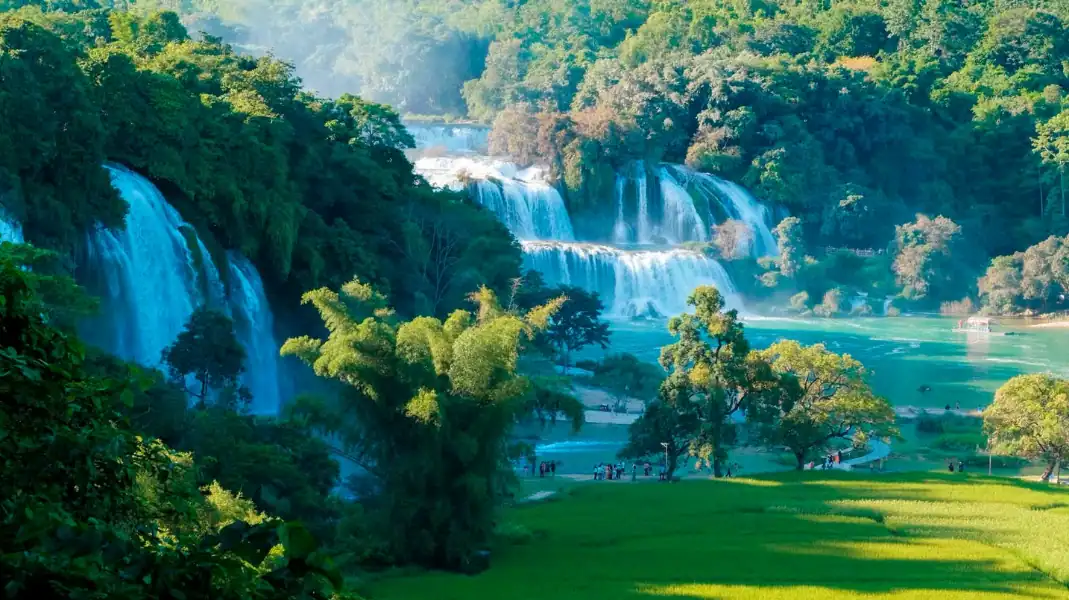
On the Chinese side, the same falls are called Detian, in Guangxi. Over thousands of years, the water has eaten back into the rock and split the falls into two parts, which Vietnamese call the main fall and the secondary fall. After heavy summer rain they can join again into one curtain of water.
Ban Gioc at a glance:
| Attribute | Value |
|---|---|
| Location | Former Trung Khanh district, Cao Bang province, Vietnam |
| River | Quay Son River (Gui River on the Chinese side) |
| Height | 30 meters (primary drop); 3-tier total up to 70 meters |
| Width | 200 to 300 meters at peak wet season flow |
| Border | Shared between Vietnam and China |
| Geopark Status | Within Non Nuoc Cao Bang UNESCO Global Geopark (recognized 2018) |
| Entrance Fee | 45,000 VND per adult (motorbike parking: 10,000 VND) |
| Bamboo Raft Fee | 50,000 VND per person |
| Distance from Hanoi | 370 kilometers (7–8 hours by car/bus) |
| Distance from Cao Bang City | 85 kilometers (2–2.5 hours by car) |
Measurements vary from source to source, because the falls change with the season and with how you count the tiers. What does not change is the scale: standing in front of it, you feel very small.
When to visit Ban Gioc
Timing decides whether you see a roaring curtain or a few separate streams.
Rainy season (June to September)
- Water: the most water, with all the tiers running.
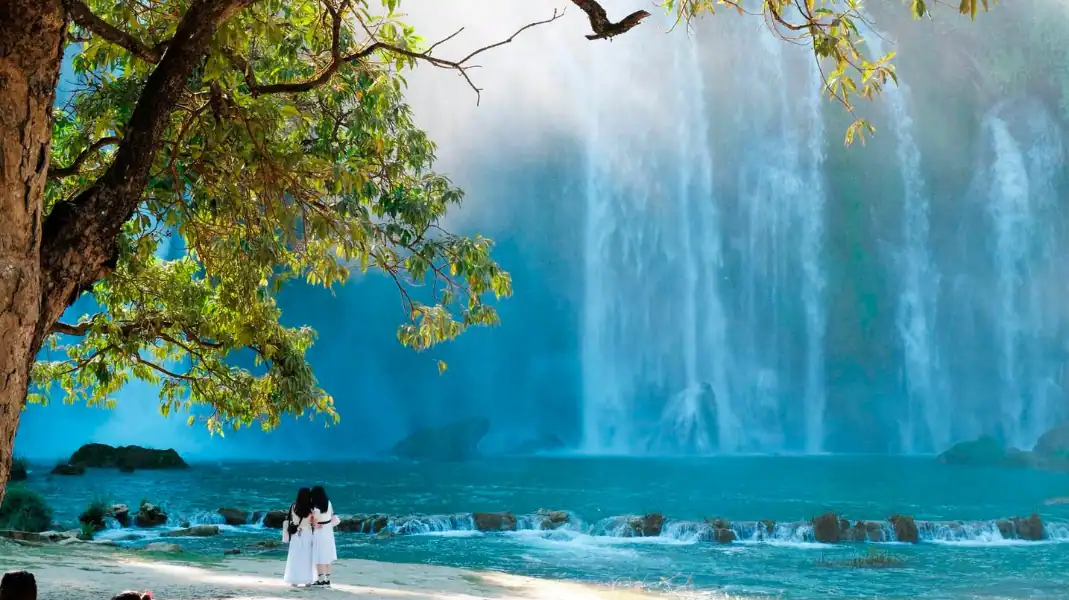
- Colour: often brown or milky after rain, jade-green on calmer days.
- Crowds: busy on Vietnamese holidays and weekends.
- Roads: landslides are possible on the narrow mountain roads. Travel with an experienced driver or rider.
Dry season (October to May)
- Water: less, sometimes much less in late winter and spring. The main fall still runs.
- Flow: the amount of water can change during the day. Ask locally on arrival.
- Scenery: in September and October, the rice fields around the falls turn gold.
- Roads: usually dry and easy.
Our choice: September or early October. There is still plenty of water, and the rice in the valley is golden. Expect 18°C to 28°C.
Getting to Ban Gioc from Hanoi
The roads are beautiful but long, so plan carefully. These are the main ways to get there:
From Hanoi to Ban Gioc:
| Method | Journey Time | Approximate Cost | Notes |
|---|---|---|---|
| TVPalm Private Tour (Car/Motorbike) | 7–8 hours to Cao Bang + 2.5 hours to falls | Included in tour package | Guided, fully organized, permit handled |
| Private Car Hire (Hanoi) | 8–9 hours | $80–$150 USD round trip | Flexible but no guide or permit support |
| Sleeper Bus (Hanoi → Cao Bang) | 7–8 hours overnight | 200,000–280,000 VND | Arrives at Cao Bang city; need separate onward transport |
| Local Bus (Cao Bang → Trung Khanh) | 2–2.5 hours | 60,000–80,000 VND | Hoa Hin buses depart near Bang Giang Hotel daily |
Important: the last part of the road runs close to the Chinese border. Carry your passport; there are checkpoints on the way.
What to do at Ban Gioc
Most visitors spend half a day at the falls. A full day lets you add the cave and the pagoda nearby.
Bamboo raft to the foot of the falls
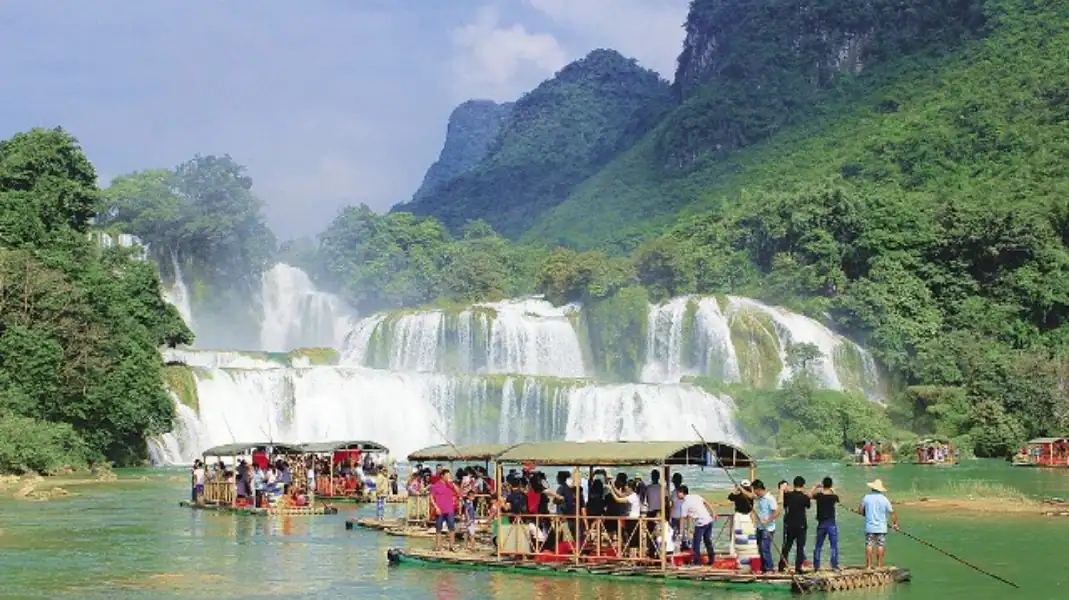
Bamboo rafts leave from near the entrance and cross the pool below the falls in about 20 minutes. You will see rafts from both countries on the water, each on its own side of the border line.
The raft takes you close to the main fall, close enough to feel the spray and hear the roar. Prices change; ask at the ticket office.
Nguom Ngao Cave (a few kilometres from the falls)
Nguom Ngao means “tiger cave” in the Tay language. A walkway leads for about 2 km through large chambers of stalactites and stalagmites.
Inside it stays cool all year. Bring a light layer; there is an entrance fee.
Truc Lam Ban Gioc pagoda
The pagoda stands on the hillside above the river, a short walk from the falls entrance.
Steps lead up in about 15 minutes, to a terrace with a view over the falls, the rice fields and the karst hills running into China.
The light on the water is best in the morning.
TVPalm tours that include Ban Gioc
Two of our Northeast Vietnam trips include Ban Gioc. We arrange the permits, transport and border-area paperwork.
Ha Giang Loop, 7 days 6 nights (from $885 per person)
The whole Ha Giang Loop, then on to Cao Bang, Ban Gioc and Ba Be Lake.
- Ban Gioc day (day 5): Khuoi Ky stone village → Nguom Ngao Cave → Ban Gioc → Phuc Sen blacksmith village → Cao Bang.
- Group: your own private group, 2 to 8 guests.
- Transport: easy rider for the loop, private car for the long road sections.
- Included: all meals, private rooms, English-speaking guide, PVI Inbound insurance and border permits.
See the full itinerary: TVPalm 7-day Ha Giang – Ban Gioc – Ba Be tour.
Ha Giang Loop and Cao Bang, 8 days 7 nights
Our longest trip, for slow travellers who want more time with the people and the landscape.
- Ban Gioc: on day 5 or 6, depending on the season.
- Also on this trip: Angel Eye Mountain (Nui Mat Than), a boat on Ba Be Lake, the Tay village of Pac Ngoi and Hua Ma Cave.
- Price: from $1,050 per person.
Before you go: checklist
- Carry your passport for the checkpoints
- Bring small notes for the raft, the cave and parking
- Wear shoes with grip; the path to the rafts is wet stone
- Bring a dry bag for your phone and camera on the raft
- Arrive early at weekends, before the crowds
- In October, check the cave’s opening and queues before you go
Frequently asked questions
Can I swim near Ban Gioc?
No. Swimming is not allowed near the falls. The current is strong, especially in the rainy season, and the border runs through the water. Stay on the raft and follow the staff.
How many days should I spend in Cao Bang?
At least two days. Day 1: Ban Gioc and Nguom Ngao Cave. Day 2: Angel Eye Mountain and Khuoi Ky stone village, then on to Ba Be Lake. One day is too rushed.
Is Ban Gioc in a protected area?
Ban Gioc lies in the Non Nuoc Cao Bang UNESCO Global Geopark, recognised on 12 April 2018 and re-confirmed by UNESCO since. The geopark covers more than 3,000 km² of Cao Bang province and records over 500 million years of Earth’s history. Since September 2023, Vietnam and China have also run a pilot tourism scheme at the falls themselves; check the current rules before you go.
Written by Nguyễn Văn Trung, founder of TVPalm. He has led small-group trips across Northeast Vietnam since 2021.


