

Xa Phin is an ancient Dao Ao Dai mountain village perched at 1,000 meters altitude on the eastern slopes of Tay Con Linh, famous for its historic stilt houses blanketed in thick green moss and old-growth Shan Tuyet tea forests.
At TVPalm Adventure, our expedition teams lead low-impact treks that connect Ha Giang City through indigenous forest corridors directly into Xa Phin. This comprehensive field guide covers trail logistics, village geography, seasonal moss cycles, homestay customs, and critical navigation details for travelers exploring Northern Vietnam’s most scenic highlands.
Understanding Xa Phin Mossy Roof Village & Heritage
Location and Geography on Tay Con Linh
Xa Phin is an indigenous upland settlement located in Phuong Tien Commune, Vi Xuyen District, Ha Giang Province, situated approximately 20 kilometers northwest of Ha Giang City on the forested slopes of the Tay Con Linh mountain range. The village sits at an average altitude between 950 meters and 1,100 meters above sea level.
It is inhabited exclusively by the Dao Ao Dai (Long-Tunic Dao), a distinctive subgroup of the Yao people who have cultivated high-altitude tea gardens and terraced rice paddies across these ridges for multiple generations.
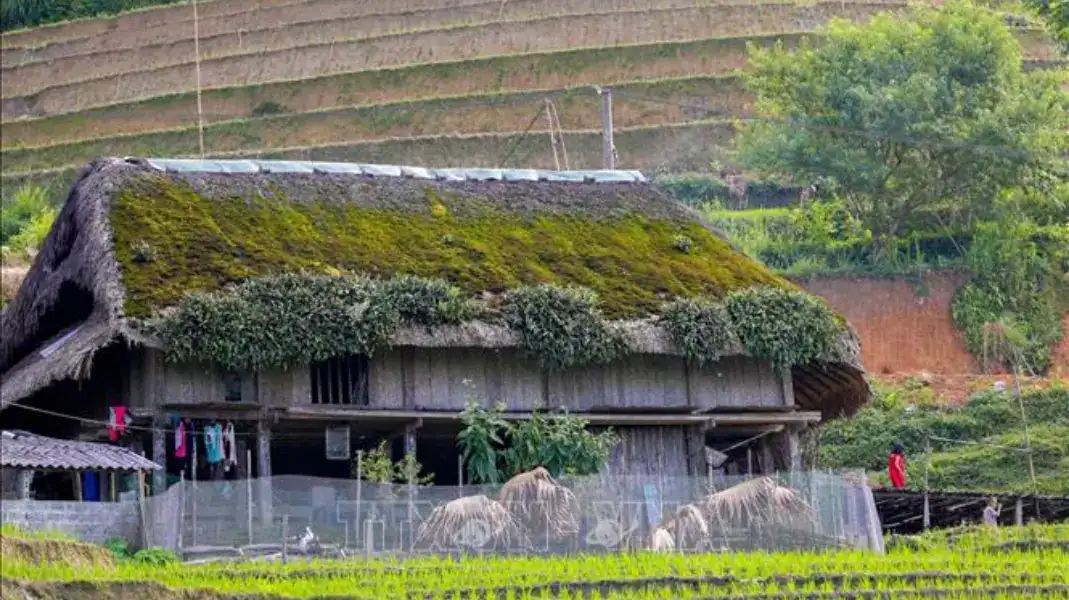
What sets Xa Phin apart from all other highland settlements across Northern Vietnam is its striking architectural signature: traditional multi-tiered wooden stilt houses roofed with native mountain palm leaves (la co) that are covered in velvet-like coats of living green moss.
Because the village nestles in a high-altitude cloud belt characterized by persistent moisture, heavy fog, and cool temperatures year-round, the thatched palm roofs do not decay quickly. Instead, they foster dense micro-colonies of moss and ferns that accumulate over twenty to thirty years, creating organic green roofs that insulate the homes against winter frosts and summer sun.

| Geographic & Cultural Parameter | Village Specification Detail |
|---|---|
| Administrative Location | Xa Phin Village, Phuong Tien Commune, Vi Xuyen District, Ha Giang Province |
| Elevation Range | 950 meters to 1,150 meters above sea level |
| Dominant Ethnic Group | Dao Ao Dai (Long-Tunic Dao) |
| Total Households | Approximately 50 to 60 traditional wooden stilt houses |
| Signature Architectural Feature | Palm leaf thatched roofs covered in 5 to 10 cm of living green moss |
| Primary Agricultural Heritage | Ancient wild Shan Tuyet tea trees (Camellia sinensis), terraced rice, cardamom |
| Microclimate Profile | Montane humid subtropical; persistent mist, high moisture, cool mountain air |
| Trekking Distance from Ha Giang City | 16 to 18 kilometers via mountain footpath (Thon Tha – Lung Vai – Xa Phin) |
The Science and Heritage of the Green Mossy Roofs
The green moss on the roofs of Xa Phin is a living testament to a harmonious microclimate and centuries of sustainable vernacular architecture. Unlike modern corrugated metal or baked tile roofs that overheat in the afternoon and chill quickly at night, local palm thatch acts as an organic, breathable sponge.
Local Dao builders harvest mature palm leaves from native highland palm groves. They weave several thousand tightly overlapping fronds onto a split-bamboo framework to form a steep, rain-shedding canopy. The average thickness of the freshly thatched roof measures 15 to 20 centimeters.
Over five to ten years of continuous exposure to mountain mist, fungal spores, and moisture, microscopic bryophytes take root within the organic fibers. The moss layer gradually thickens to 5 to 10 centimeters. This living vegetal coat provides two remarkable practical benefits:
- Thermal Insulation: The dense moss cushions the interior from extreme mountain cold during winter months, keeping indoor hearth fires warm, while reflecting intense solar radiation during the dry season.
- Acoustic Dampening: During torrential summer monsoon downpours, the thick moss absorbs the impact of heavy raindrops, preventing the deafening drumming noise typical of metal sheet roofing.
Xa Phin (Vi Xuyen) vs. Sa Phin (Dong Van): Avoiding Misconceptions
A frequent navigational error made by independent travelers and foreign motorcyclists in Ha Giang is confusing Xa Phin (spelled with an X) in Vi Xuyen District with Sa Phin (spelled with an S) in Dong Van District. Although the names sound nearly identical to foreign ears, they are two completely different geographic locations separated by more than 130 kilometers of treacherous mountain roads.
- Xa Phin (Vi Xuyen District): Located on the lush, green, forested slopes of Tay Con Linh near Ha Giang City. This is the secluded, mossy-roof stilt house village surrounded by tea trees and bamboo where travelers go for off-the-beaten-path hiking and quiet eco-homestays.
- Sa Phin (Dong Van District): Located in the high karst plateau of the Dong Van Geopark along the main Ha Giang Loop highway (QL4C). This is the rocky limestone valley famous for the H’mong King’s Palace (Dinh Vua Meo), a historical stone and wood fortress visited by thousands of tour groups weekly.
When booking transportation, renting motorbikes, or downloading offline GPS tracks, verify that your route leads toward Phuong Tien Commune in Vi Xuyen District, not Dong Van.
Ancient Shan Tuyet Tea Heritage of Xa Phin
Xa Phin is one of the premier high-altitude habitats for centuries-old wild Camellia sinensis var. assamica tea trees, known locally as Shan Tuyet (Snow Shan) tea. Rising directly from the misty mountain ridges surrounding the village, these ancient gnarled trees grow to heights of 8 to 15 meters, with thick trunks wrapped in pale lichens and moss.
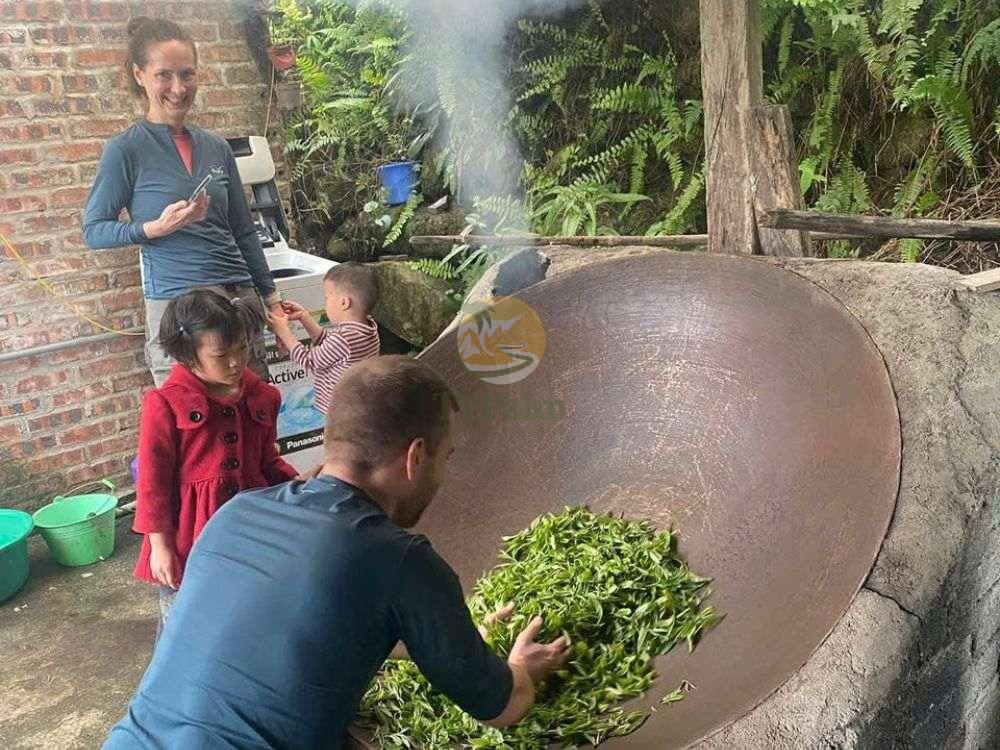
The Dao Ao Dai people of Xa Phin harvest the pristine buds and leaves by climbing high into the tree crowns during early morning mist. The newly sprouted tea buds are coated with dense white down, which resembles snow crystals and gives the tea its name.
Because the trees grow wild at high elevation without chemical fertilizers or synthetic pesticides, Xa Phin Shan Tuyet tea yields a liquor with subtle floral notes, high concentrations of natural amino acids, and a rich honeyed aftertaste (hau ngot). Bathers and trekkers staying at local homestays are welcomed with hot infusions brewed using pure spring water piped directly from mountain ravines.
Signature 2-Day Trekking Route to Xa Phin
Trekking into Xa Phin on foot is the only way to experience the transition from lowland Tay ethnic villages to high-altitude Dao cloud forests. The trail climbs steadily along stream valleys, through terraced rice amphitheaters, and across steep bamboo ridges.
| Trek Stage & Route Segment | Distance & Terrain Profile | Elevation Change | Key Highlights & Landmarks |
|---|---|---|---|
| Day 1: Ha Giang City to Thon Tha & Lung Vai | 6.5 km; dirt footpaths, farm bunds, gentle ascents | +250 m | Tay stilt houses, crystal fish ponds, palm groves |
| Day 1: Lung Vai to Xa Phin Village | 8.5 km; rocky jungle paths, steep switchbacks | +680 m | Ancient tea trees, mountain water pipes, mossy roofs |
| Overnight in Xa Phin | Homestay rest & cultural dinner | 1,020 m | Herbal foot bath, woodfire dinner, Shan Tuyet tea |
| Day 2: Xa Phin to TVPalm Ecolodge / Phuong Tien | 7.0 km; downhill ridge descent, bamboo groves | -650 m | Panoramic valley vistas, rushing waterfalls, hot baths |
Day 1: Ascending into the Clouds (Thon Tha to Xa Phin)
The expedition departs after breakfast from the lowlands near Ha Giang City. The initial three kilometers traverse the idyllic Tay ethnic village of Thon Tha, where traditional thatch homes sit beside duck ponds and emerald paddy fields.
Passing through Lung Vai village, the gradient steepens noticeably. The trail leaves motorable tracks behind, entering dense montane forest where towering bamboo arches create natural shaded tunnels. As elevation passes 800 meters, the ambient air cools, mist gathers among the tree canopy, and the first scattered tea groves appear.
By mid-afternoon, hikers emerge onto the ridge opening into Xa Phin, greeted by the sight of smoke drifting lazily from moss-draped palm roofs.
Day 2: Exploring Ancient Tea Forests and Descending
Waking up in Xa Phin to the sound of roosters and high-altitude birdcalls, travelers can join local Dao hosts for a morning walk through heritage tea groves. After breakfast of hot pancakes with wild forest honey, the trek begins its gradual descent along the southern ridge toward Phuong Tien and TVPalm Ecolodge.
The descent offers breathtaking panoramic views of the Ha Giang river basin far below before ending with a therapeutic herbal bath.
Practical Travel Logistics and Cultural Etiquette
Essential Packing Checklist for the Xa Phin Trek
Because trails on the slopes of Tay Con Linh are frequently wet, steep, and shrouded in cloud mist, proper footwear and moisture management are paramount:
- Lugged Trail Footwear: Sturdy hiking boots or trail running shoes with deep rubber lugs (Vibram or Contagrip) to grip slippery red clay and mossy rocks.
- Trekking Poles: Essential for maintaining balance and relieving joint impact during steep descents on slippery soil.
- Lightweight Waterproof Shell: A breathable rain jacket (GORE-TEX or similar) to protect against sudden mountain showers and wind chill.
- Dry Bags or Waterproof Backpack Liner: Keeps electronics, dry clothing, and sleeping gear completely dry inside your pack.
- Modest Homestay Clothing: Long pants and comfortable shirts made from quick-drying synthetic fabric; avoids revealing attire to respect local cultural customs.
- Headlamp with Spare Batteries: Village footpaths lack street lighting; a bright headlamp is indispensable for walking between houses at night.
“When you hike through the cloud boundary above Lung Vai and step into Xa Phin, time slows down. The green moss on those palm roofs is not just beautiful scenery – it is living history, preserved by Dao elders who understand how to live in balance with the forest.”
Văn Trung Nguyễn, TVPalm Adventure
Responsible Travel and Cultural Etiquette in Xa Phin
Xa Phin remains an authentic, working agricultural community. Trekkers must respect the following local social norms and environmental practices:
- Always Ask Before Photographing Villagers: Seek permission with a polite smile before taking portraits of village elders, women working on indigo textiles, or children.
- Remove Footwear Before Entering Homestays: Leave muddy trail shoes on the wooden threshold or exterior porch; never walk into living areas with outdoor shoes.
- Do Not Touch the Sacred Altar: The family ancestral altar is situated in the central bay of the stilt house; never point feet toward the altar or place luggage nearby.
- Pack Out All Non-Biodegradable Waste: Plastic bottles, snack wrappers, and personal hygiene products must be carried back to Ha Giang City for proper disposal.
Frequently Asked Questions About Xa Phin Village
When is the best time of year to see the mossy roofs in Xa Phin?
The best season to view the moss on the roofs is from October through April. During this autumn, winter, and early spring period, high humidity and continuous mountain mist keep the moss exceptionally lush, dense, and emerald green. Between September and October, the visit also coincides with the golden terraced rice harvest.
Can travelers reach Xa Phin Village by motorbike or car?
A narrow concrete road now connects Phuong Tien to parts of Xa Phin, but it is exceptionally steep, narrow, and often obstructed by mud or loose gravel during rainy spells. Only highly experienced motorcyclists riding manual dirt bikes should attempt the ascent.
Cars cannot reach the traditional stilt houses. The safest, most scenic, and most environmentally responsible method of visiting is hiking with a local guide.
What kind of food and sleeping accommodations are available in Xa Phin?
Accommodations consist of family-run Dao stilt houses offering clean shared sleeping quarters with individual mattresses, warm blankets, and mosquito nets.
Hosts prepare generous communal dinners featuring pasture-raised mountain chicken, wild forest vegetables, smoked pork, and homegrown rice, accompanied by hot Shan Tuyet tea and traditional herbal foot baths.


