

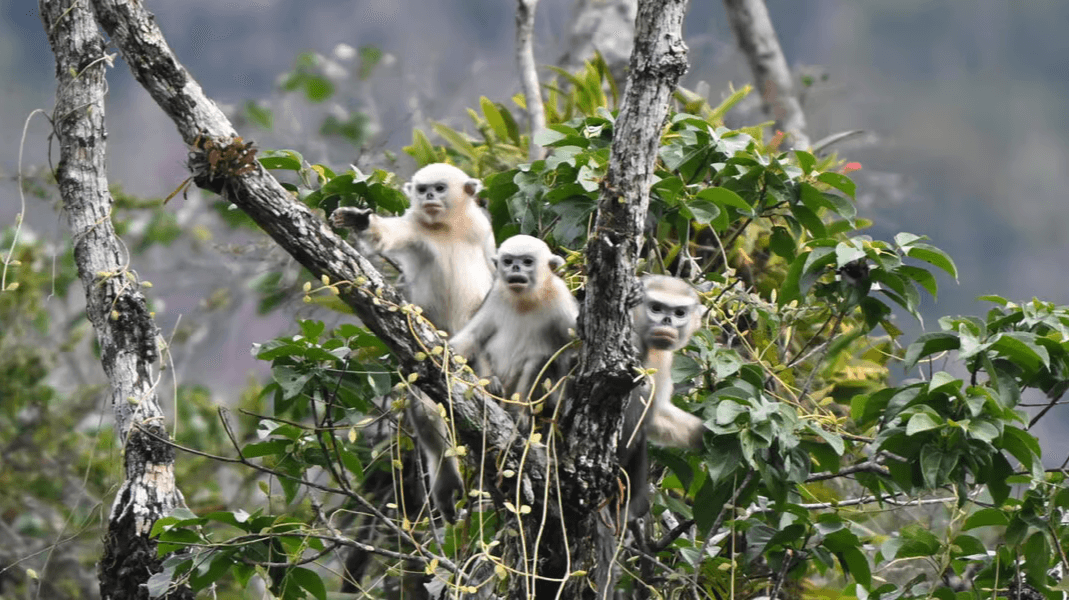
A Tonkin snub-nosed monkey tour is not a standard wildlife safari. The Tonkin snub-nosed monkey (Rhinopithecus avunculus) is one of the rarest primates on Earth: Critically Endangered on the IUCN Red List, a regular on the list of the world’s 25 most endangered primates, and found only in northern Vietnam.
Planning to go? We run two ranger-led treks into the Khau Ca forest, never more than 6 guests: the 2-day trek, with one dawn in the habitat, and the 3-day trek, with three. Compare both treks. Bookings open on 1 January 2027.
Most of the survivors live in Khau Ca, a limestone forest in Ha Giang (part of Tuyen Quang province since July 2025), inside a strictly protected zone that no public tourist trail enters.
TVPalm Adventure is a licensed international tour operator (licence 02-026/2025/TCDL-GP LHQT). We will take bookings for these tours from 1 January 2027.
The Tung Ba–Khau Ca area is managed by the Du Gia Special-Use Forest, and we are still completing the permits with its management board. Until they are in place, we do not sell this trip.
Why we plan to start from Tung Ba
Some operators advertise snub-nosed monkey tours that turn out to be general Loop trips. We would rather say clearly what we are building. Our planned route enters Tung Ba, a remote village where the forest buffer zone meets Khau Ca, now part of Du Gia National Park and managed as special-use forest.
The latest census, carried out by Fauna & Flora (FFI) with the forest authorities in late 2025, counted around 160 monkeys in Khau Ca, including several new infants: roughly four out of five of all that remain. In the early 2000s, only a few dozen were left there.
- Forest: steep limestone forest, with no maintained tourist paths.
- The monkeys: they live high in the trees and move over a wide area, so sightings are never certain.
- Protection: Khau Ca is special-use forest under Vietnam’s Forestry Law, protected with the help of local patrol teams supported by FFI.
- Ranger escort: every visit will go with a forest ranger, as the permit requires.
- Legal status: TVPalm holds International Tour Operator Licence No. 02-026/2025/TCDL-GP LHQT, issued on 21 April 2025. Entry permits for the Khau Ca area are being completed with the Du Gia Special-Use Forest management board.

What we are building: not a zoo experience, but small, quiet visits into the living habitat, always with a forest ranger, so that tourism helps the people who protect the forest rather than disturbing the monkeys.
The two formats we plan to open in 2027
We plan two formats into the forest at Tung Ba. Both would depart from Ha Giang city or TVPalm Ecolodge, with an English-speaking TVPalm guide and a forest ranger. The details below are our working plan and may change with the permit conditions.
Option 1: 2 days, 1 night
Best for: travellers who want a real wildlife trek without adding more than two days to their trip.
Walking: about 10 km over two days. Night: at the forest ranger station near Tung Ba, a simple working outpost with no electricity or hot water. Sleeping bags or blankets are provided by TVPalm.
Day 1:
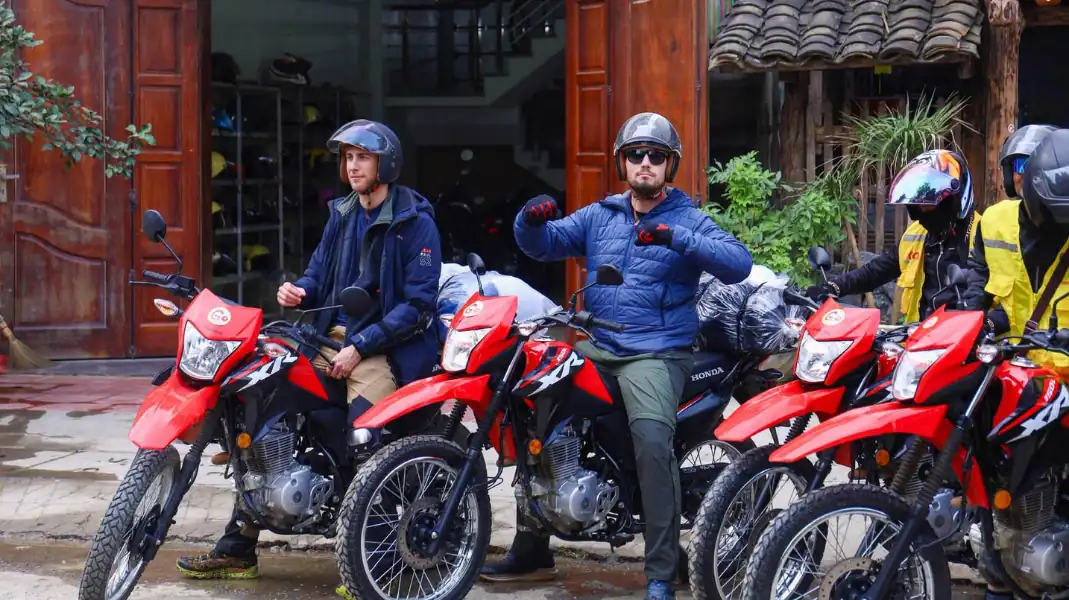
- Early morning: leave Ha Giang city or TVPalm Ecolodge by motorbike or car.
- Arrive in Tung Ba and meet the forest ranger.
- Walk into the forest, crossing streams and climbing limestone hills.
- Picnic lunch in the forest, and take all rubbish back out.
- Afternoon: continue with the ranger, who shares what he knows of the forest and signs of the monkeys.
- Late afternoon: reach the ranger station and rest.
- Evening: dinner and conversation about the forest and its protection.
- Night at the ranger station.
Day 2:
- Dawn: a quiet walk with the ranger, the best time to look for the monkeys.
- Breakfast at the station.
- Continue by another route through the forest.
- Picnic lunch on the trail.
- Walk down to the village.
- Transfer back to TVPalm Ecolodge or Ha Giang city.
Planned to include: return transfer, English-speaking guide and forest ranger, entry permits, 1 night at the ranger station, meals during the trek, drinking water, sleeping bag or blanket, first-aid kit and PVI inbound travel insurance. Details will be confirmed with the permit.
Option 2: 3 days, 2 nights (extended)
Best for: wildlife photographers, naturalists and travellers who want more chances to see the monkeys.
The key difference: about 18 km over three days, with two nights in the forest and three early mornings to look for the monkeys. If the first dawn brings nothing, you still have two more chances. Which areas we may enter will depend on the permit conditions.
Day 1: as in the 2-day option: arrival, walk into the forest, night at the ranger station.
Day 2:
- Dawn: a quiet search with the ranger.
- Breakfast at the station.
- A longer walk through the forest, only where the permit and the ranger allow.
- Picnic lunch in the forest.
- Afternoon: time to watch and listen, depending on where the monkeys have been seen.
- Return to the ranger station.
- Dinner and the second night in the forest.
Day 3:
- Dawn: a last chance to look for the monkeys.
- Breakfast, and pack up, leaving nothing behind.
- Walk down to Tung Ba by another route.
- Lunch in the village.
- Transfer back to TVPalm Ecolodge or Ha Giang city.
- Arrive in the late afternoon.
Planned to include: as in the 2-day tour, plus one more night at the ranger station and the extra meals.
The two formats at a glance
| 2 days, 1 night | 3 days, 2 nights | |
|---|---|---|
| Walking | About 10 km | About 18 km |
| Dawn chances to look for the monkeys | 1 (day 2) | 3 |
| Nights at the ranger station | 1 | 2 |
| Sighting | Not guaranteed | Not guaranteed, but more chances |
| Best for | First-time wildlife trekkers | Photographers, naturalists and keen wildlife travellers |
What to expect: fitness and preparation
Both formats involve demanding walking on steep, slippery limestone with no maintained paths. These are not walks in a nature park.
You should be:
- Able to walk several hours a day on rough, uneven ground
- Comfortable on steep slopes without handrails
- Free of knee or ankle problems that make steep descents hard
- Able to carry your own small daypack
What to bring:
- Trekking boots with a good grip: trail shoes are not enough on the steep rock
- A rain jacket: the forest is humid, and showers can come without warning
- Long sleeves and long trousers, against plants, leeches and insects
- Travel insurance that covers trekking in remote areas
Sightings are not guaranteed on either tour. The Tonkin snub-nosed monkey is wild and moves across a large area of broken limestone forest. Rangers can read signs of where a group has been, but cannot say exactly where it will be. The 3-day tour gives more early-morning chances, but no promise.
How to register your interest for 2027
Bookings open on 1 January 2027. Until then, write to us and we will tell you when dates and prices are confirmed. We reply within 24 hours.
- Contact: info@tvpalm.com or WhatsApp +84 366 885 955
- No payment required until you confirm dates
- Free personalised itinerary and quote based on your group and dates
- Licensed international tour operator: International Tour Operator Licence No. 02-026/2025/TCDL-GP LHQT
FAQ
Is a sighting guaranteed?
No. TVPalm does not guarantee sightings on either tour. The monkeys are wild animals in a large forest, with no enclosures or feeding stations. The 2-day tour offers one main chance, at dawn on day 2.
The 3-day tour will offer three dawn chances. The guide will choose where to look each morning with the ranger. We will publish real sighting figures once the tour has run for a full season.
We will not make promises about the best months until we have our own records.
What is the ranger station like?
The station is a working forest patrol outpost, not a tourist facility. It has a wooden floor, a roof and access to stream water.
There is no electricity, no hot water and no beds: guests sleep on the floor in sleeping bags or blankets provided by TVPalm. This is where the rangers sleep during their patrols, and we say so clearly because it is important to know before you book.
We have not taken guests there yet. What we can tell you is what the rangers describe: deep silence, forest sounds at night and, on clear nights, a sky full of stars.
Can I join as a solo traveller?
Yes. Both tours will be private, for one person or a small group. Solo bookings will depend on ranger availability and seasonal access. TVPalm does not run shared departures.
Prices will be adjusted to the size of your group. Contact TVPalm for a quote.
Written by Nguyễn Văn Trung, Founder of TVPalm.


