

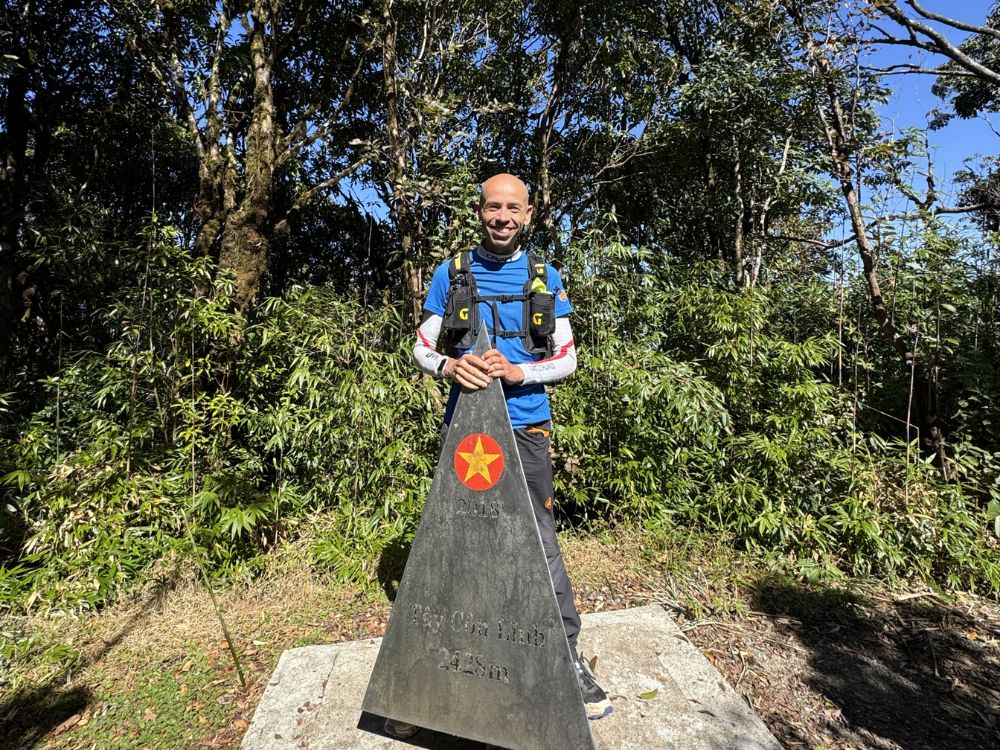
Tay Con Linh (2,428 m), the highest peak in Northeast Vietnam, is a gift for photographers: moss-roofed stilt houses in Xa Phin, old Shan Tuyet tea forests, cloud forest, and, on a good day, a sea of clouds below the granite summit.
This guide covers 13 places to photograph on and around the mountain, from the villages at the foot to the summit, with the best light, the lenses that work, and how to protect your camera in the damp.
1. The 2,428 m granite summit
The top of the trek is the summit marker among granite boulders at 2,428 m. Get low with a wide-angle lens (16–35 mm) to show the rock in front and the marker against the ridges running towards China.
You reach the summit in the late morning, not at sunrise: there is no overnight stay on the mountain. Between October and April, the clouds often still sit below the peak at that hour. Bring a light tripod, shoot at ISO 100, f/8 to f/11, and bracket your exposures (-2, 0, +2 EV) for the bright sky and dark rock.
2. The roofs of Xa Phin
Xa Phin, a Dao Ao Dai village in a cloud basin, is known for its stilt houses covered in thick green moss. The mountain fog works like a huge softbox: no hard shadows, and very rich greens on the roofs.
The best light is from 07:00 to 09:30 on misty or overcast mornings, with a 35 mm or 50 mm f/1.8 lens for detail with a soft background. Ask before photographing anyone; many women here wear embroidered indigo clothes, and some are happy to be photographed on their veranda, some are not.
3. The old Shan Tuyet tea forest
Higher up grow old Shan Tuyet tea trees, many of them hundreds of years old, their trunks covered in lichen, moss and orchids. A 24–70 mm lens works well when the morning mist moves through the canopy.
Go early (07:30 to 09:00) during the spring (March to April) or autumn (September to October) picking, when Dao women pick the silvery buds into bamboo baskets. Ask before you photograph them at work.
4. The rice terraces of Khuoi My
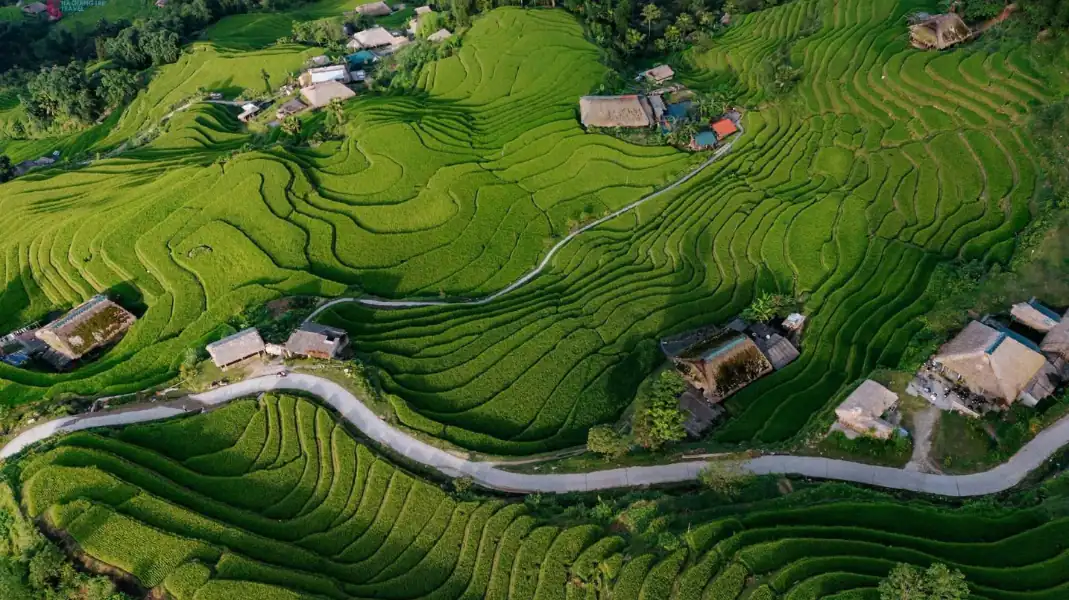
Above Phuong Do commune, Khuoi My has terraces held up by stone walls on steep slopes. A 70–200 mm telephoto compresses the curves of the terraces and the farmers working in them.
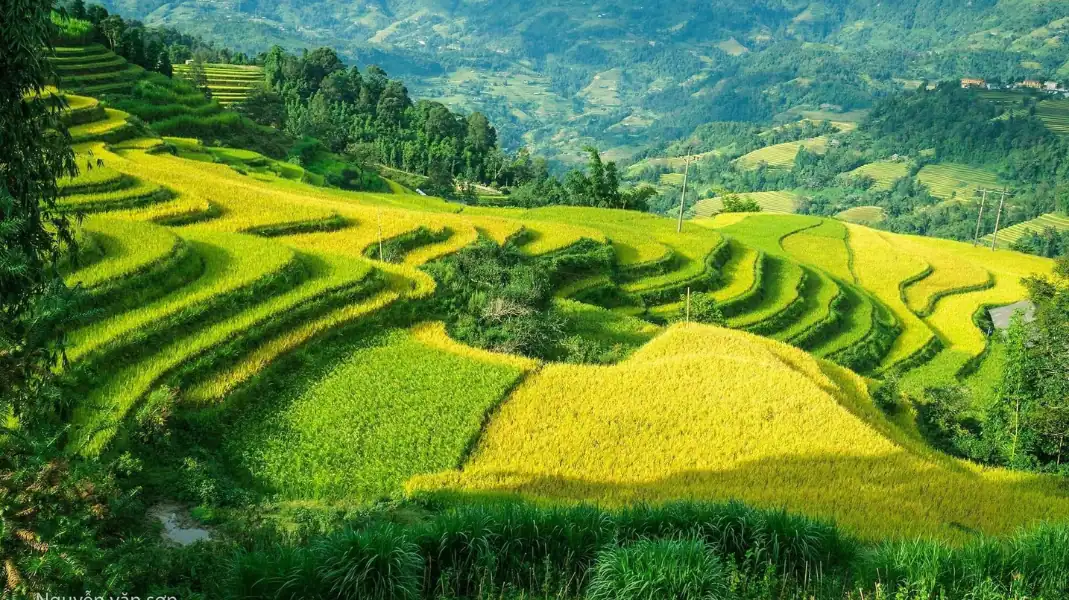
The best light is from 16:00 to 17:30 in September and October, when the low sun turns the harvest gold.
5. Huou waterfall and the granite pools
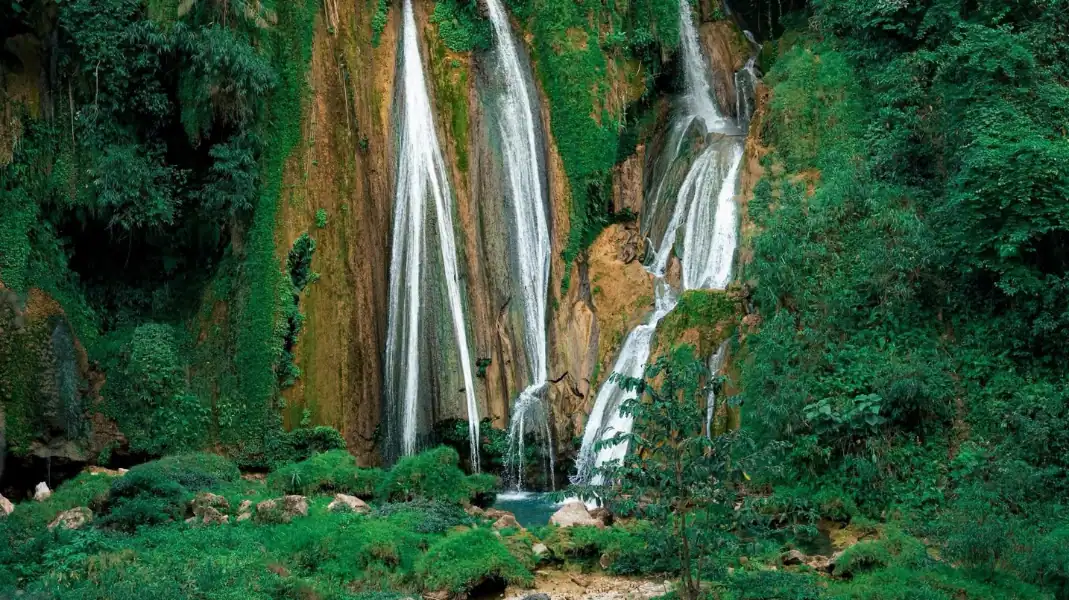
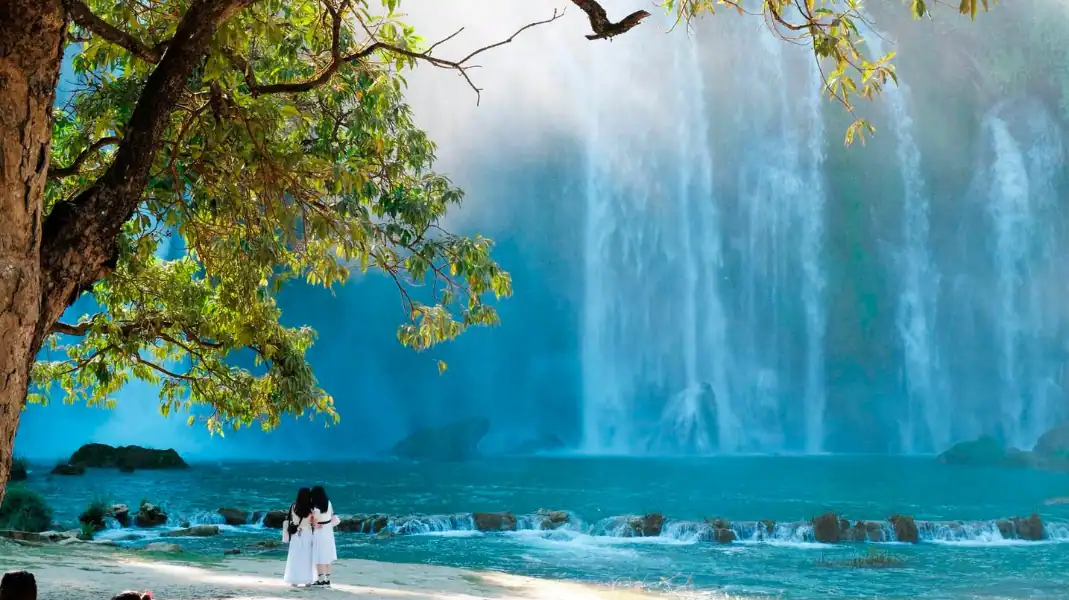
In the forest near Xa Phin, Huou waterfall drops over granite ledges into clear pools. In flat midday light, a 6-stop or 10-stop ND filter with a polariser and a 2- to 4-second exposure gives silky water.
6. Thon Tha, the Tay stilt-house village
About 2 km from TVPalm Ecolodge, Thon Tha is a quiet Tay village of wooden stilt houses. Go early (06:00 to 07:30), when kitchen smoke drifts over the roofs and the streams reflect the palms. A 24–70 mm zoom covers village life, buffalo and fields.
7. Water wheels and giant bamboo
Along the streams between Thon Tha and Lung Vai, wooden water wheels (coi nuoc) lift water into bamboo channels for the fields.
The best light is mid-morning (08:30 to 10:00), when the sun breaks through the bamboo. A polariser deepens the greens and the wet wood.
8. Giant tree fern valleys
Above the tea, the trail enters cloud forest with giant tree ferns. Ask a walking companion in a bright jacket to stand on the path, for scale against the fern fronds and moss-covered branches.
9. The high ridge trails
Between about 1,800 and 2,200 m, the path follows narrow ridges with misty drops on both sides. A wide angle works well in the softer light of late morning and afternoon, with walkers against the haze. Stay on the path when you photograph.
10. Wild rhododendron
From February to April, old wild rhododendrons flower red, pink and white on the upper slopes above 2,000 m. Frame flowers close in front, with the misty ridges soft behind.
11. Cardamom under the trees at Lung Vai
Under the big forest trees, Dao farmers grow cardamom. Between August and October, they harvest the red pods in dappled light. Ask before photographing.
12. Stars and the Milky Way
There is no camping on Tay Con Linh, but the night sky from Xa Phin or the ecolodge, far from town lights, can be very dark. On clear moonless nights from April to September, point a wide f/2.8 lens to the southeast for the Milky Way (about 20 seconds, ISO 3200, f/2.8).
13. The pool and Clouds Bar at TVPalm Ecolodge
After the trek, photograph the sunset over the palm forest of Phuong Do and the Tay Con Linh range from the ecolodge’s mountain-spring pool or the Clouds Bar.
Protecting your camera from the damp
| Photography Gear Item | Recommended Spec | Why It Is Essential on Tay Con Linh |
|---|---|---|
| Weather-Sealed Camera Body | Full-frame or APS-C with rubber gaskets | Protects internal electronics from perpetual 90%+ jungle humidity and mist |
| Desiccant Silica Gel Packs | 5 to 8 reusable silica gel canisters | Absorbs moisture inside camera dry bags overnight to prevent internal lens fungus |
| Circular Polarizer (CPL) | Multi-coated slim brass frame | Cuts glare on wet moss, tea leaves, and waterfalls for rich saturated colors |
| Carbon-Fiber Tripod | Lightweight compact travel tripod (under 1.3 kg) | Provides rock-solid stability for sunrise bracketing and long-exposure waterfall shots |
Photographing Tay Con Linh: common questions
Can I fly a drone on Tay Con Linh?
Tay Con Linh is in a border area, and drone flights there are restricted and need permission from the authorities. Ask us before your trip; do not fly without it.
When is the best season for photography?
October to April usually gives the clearest skies, the sharpest light and the best chance of a sea of clouds.
How do I stop my lens from fogging up?
Keep your camera in a sealed dry bag with silica gel when you move between cold air outside and a warm homestay inside, and let it warm up slowly before you open the bag.
Written by Nguyễn Văn Trung, founder of TVPalm. He has led small-group trips across Northeast Vietnam since 2021.


