

Khau Ca is a small limestone forest in the north of Vietnam, and it holds most of what is left of one of the rarest primates on Earth: the Tonkin snub-nosed monkey. Around 160 live here, roughly four out of every five of the species.
This guide explains what Khau Ca is, how the monkey came back from the edge, who protects it, and what any visit must respect. TVPalm will only start taking guests on monkey tours from 1 January 2027, once the permits are complete.

Khau Ca: the place
Where it is, and who manages it
Khau Ca is a karst forest of about 2,000 ha, set aside to protect the largest surviving population of the Tonkin snub-nosed monkey.
It lies about 40 km southeast of Ha Giang City, around the communes of Tung Ba, Minh Son and Yen Dinh. Since the provincial merger of July 2025, the area belongs to Tuyen Quang province, though everyone still calls it Ha Giang.
The forest is evergreen, growing over steep, broken limestone, roughly between 400 and 1,200 m.
In 2015, the government joined the Du Gia Nature Reserve and the Khau Ca Species and Habitat Conservation Area into Du Gia National Park, about 15,000 ha in all. Khau Ca remains its most sensitive core, managed as special-use forest.
| Khau Ca at a glance | |
|---|---|
| Protected core | About 2,000 ha of primary limestone forest |
| Location | Around Tung Ba, Minh Son and Yen Dinh; Tuyen Quang province (former Ha Giang) since July 2025 |
| Elevation | About 400 to 1,200 m |
| Status | Special-use forest, part of Du Gia National Park (since 2015) |
| Key species | Tonkin snub-nosed monkey, Critically Endangered (IUCN) |
| Conservation partner | Fauna & Flora (FFI), since 2002 |
The Tonkin snub-nosed monkey
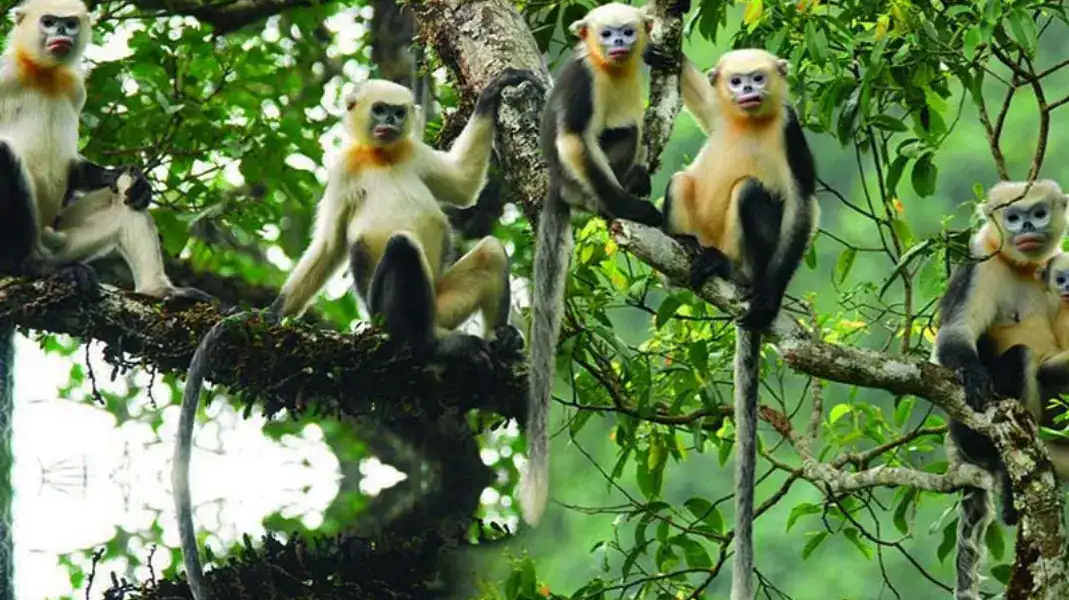
The Tonkin snub-nosed monkey (Rhinopithecus avunculus) lives only in northern Vietnam. It is listed as Critically Endangered on the IUCN Red List and on Appendix I of CITES, and it has appeared on the list of the world’s 25 most endangered primates since that list began in 2000.
It was thought lost for decades. When Fauna & Flora (FFI) confirmed a group at Khau Ca in 2002, only about 50 to 60 animals were left there.
The latest census, carried out by FFI with the forest authorities in late 2025 and published in May 2026, counted around 160 individuals in Khau Ca, including several new infants. With a world population estimated at about 250, Khau Ca holds roughly 80% of the species.
The monkeys live in family groups, usually one adult male with several females and their young, and they spend almost all their time high in the canopy.
- Scientific name: Rhinopithecus avunculus.
- Size: a slender, long-tailed monkey; males are noticeably bigger than females.
- Where it lives: only in a few forest patches in Vietnam’s far north, east of the Red River.
- How to recognise it: a turned-up nose, a pale blue face, a pink-orange throat and a dark back.
- What it eats: mostly young leaves, but also fruit, flowers and seeds from many forest plants.
Its genetic diversity is low, a sign of how small the population became. A single disease, fire or hunting season could undo twenty years of work.
How Khau Ca was protected
Khau Ca is one of the few good news stories for a primate this rare. Since 2002 the population has roughly tripled. That recovery rests on people.
After the discovery, FFI built a field station and set up community conservation teams with villagers from the communes around the forest, who patrol alongside the authorities.
The teams remove snares, record signs of illegal logging or hunting, and report what they find. The forest also received formal protection, first as a species and habitat conservation area, then as part of Du Gia National Park.
It is slow work, in hard terrain, and much of it is done by local people whose names rarely appear anywhere.
The threats have not gone away: hunting, clearing for farmland, and the simple fact that so many of the monkeys live in one small forest.
Elsewhere, the news is worse. The second-largest known population, in Quan Ba, has fallen sharply; that forest is not formally protected. FFI is now working on forest corridors to link Khau Ca with Quan Ba.
Can you visit Khau Ca?
Is Khau Ca open to tourists?
Khau Ca is not a park with a ticket office. The core forest is strictly protected, and entry needs permission from the forest authorities and an escort.
There are no boardwalks, no viewing towers and no souvenir stalls, and there should not be.
Do not walk into the forest on your own, and be wary of anyone offering an easy day trip to “see the monkeys”.
Any visit must be arranged in advance, kept small and quiet, and follow the rules of the forest managers.
- Small groups only: the fewer people in the forest, the better for the monkeys.
- Always with local rangers or community patrol members, never alone.
- No promises: the monkeys are wild and move far each day. Nobody can promise you a sighting.
Our view: this is not a show. We go into Khau Ca as guests. If the monkeys stay high in the canopy, we leave them there.
Văn Trung Nguyễn, TVPalm Adventure
How TVPalm will organise visits from 2027
TVPalm is completing the permits with the Du Gia special-use forest managers. Bookings open on 1 January 2027. Until then, you can register your interest:
Register your interest: write to info@tvpalm.com or WhatsApp +84 366 885 955. We will contact you when bookings open on 1 January 2027, with the rules agreed with the forest managers. No booking or payment before then.
Rules for watching the monkeys
The monkeys come first, before photos or comfort. They hear and smell well; noise or strong scents make them flee into the cliffs.
- Keep your distance: stay well back, at least 20 m. If a group comes closer, move away slowly.
- No flash: never use flash, and turn off camera sounds.
- Keep quiet: whisper only when you need to. Never play recorded calls or music.
- No strong smells or smoke: no perfume, scented creams or smoking in the forest.
- Take everything out: including fruit peel and food scraps.

Preparing for the forest
Weather and seasons
Conditions change a lot through the year. Wet limestone is very slippery in the rainy months, and winter mornings are cold.
| Season | Forest conditions |
|---|---|
| March to May | Drier and warmer; firmer paths |
| June to September | Heavy rain; limestone very slippery |
| October to November | Cooler and often clear |
| December to February | Cold, misty mornings; bring warm layers |
What to bring
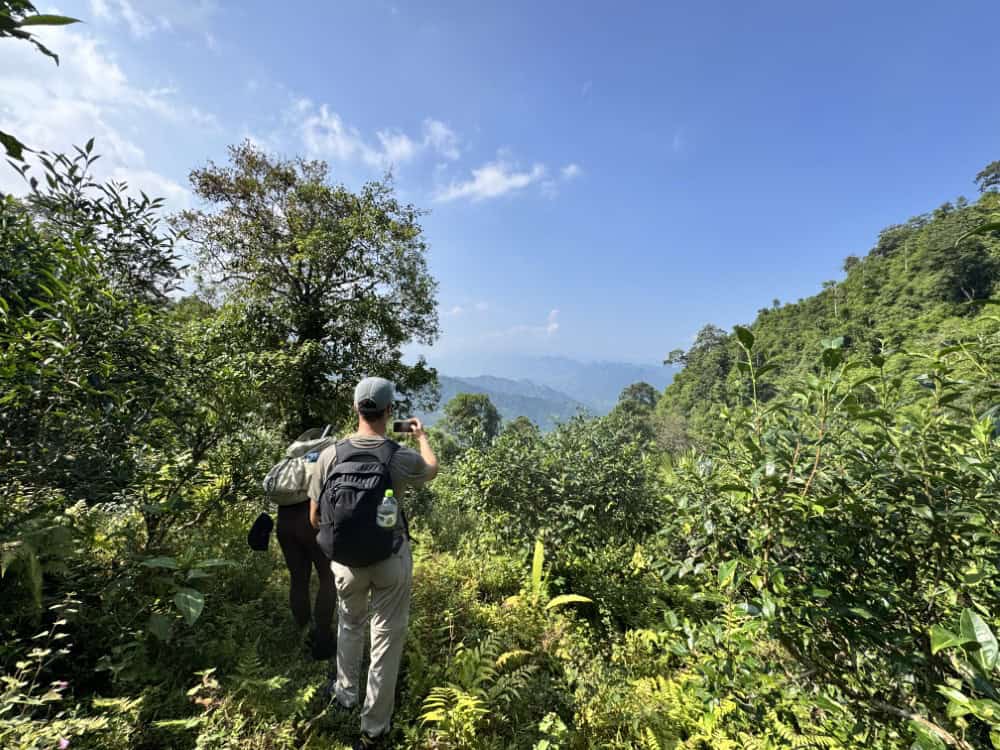
The limestone is sharp and broken, and it destroys light shoes quickly.
- Shoes: ankle-high hiking boots with deep lugs and a protective rubber edge.
- Binoculars: 8×42 or 10×42.
- Camera: a long telephoto lens (100–400 mm or more) and a light monopod, if you want photos.
- Clothes: long sleeves and tough trousers in dull colours (olive, grey, dark khaki).
- Protection: gaiters, thin gloves for the rock, and a rain hat.
- Water and food: at least 2.5 litres of water a day, rehydration salts and enough food.
Khau Ca: common questions
How far is Khau Ca from Ha Giang City, and how do you get there?
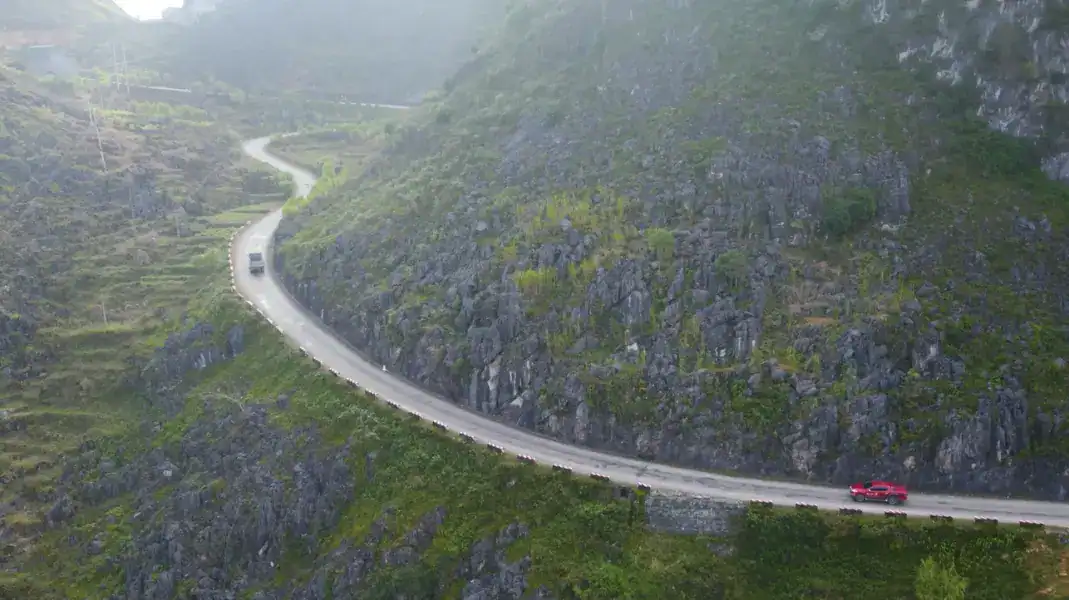
About 40 km southeast of Ha Giang City, roughly 1.5 hours by car along Highway 34 towards Bac Me, then a mountain road to the Tung Ba area.
From the village, the last part is on foot, on steep paths.
Will I see the monkeys?
Nobody can promise it. The monkeys are wild and range over a large area of broken forest; even the people who patrol it every week have days without seeing them.
That is why we will not publish sighting rates until we have run a full season.
Why not see snub-nosed monkeys somewhere easier?
The Tonkin snub-nosed monkey does not live anywhere tourists can easily go. Khau Ca is one of the very last places it survives in the wild.
A visit there is a privilege, and it only makes sense if it helps the forest and the people who protect it.


